
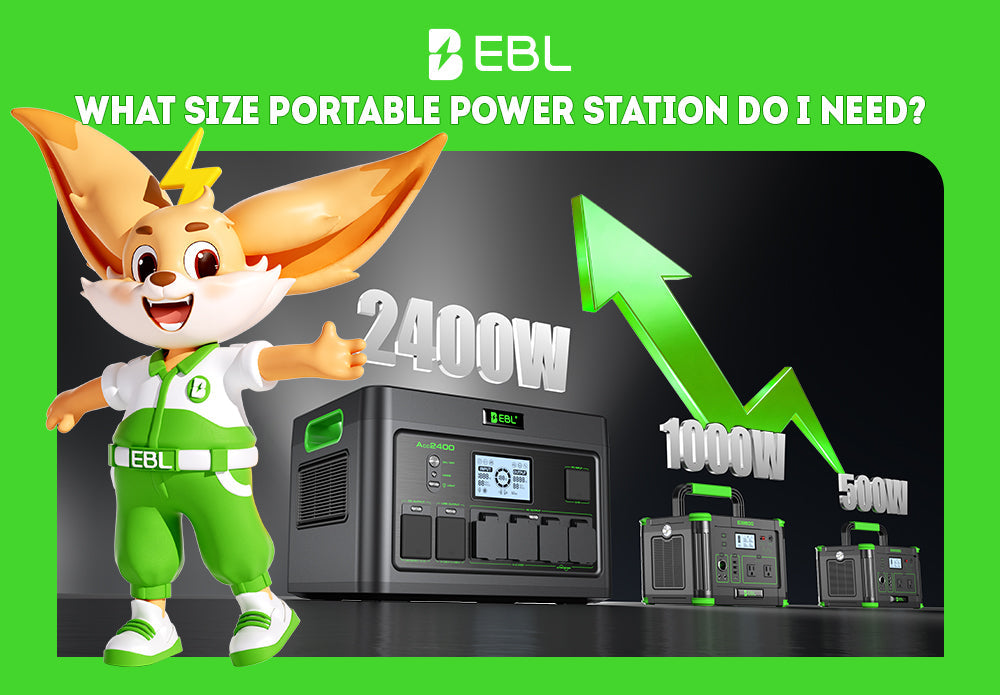
How big of a power station do I need? For most buyers, the answer depends on two numbers: the continuous wattage required by your devices and the battery capacity in watt-hours (Wh) needed for your desired runtime. A 500W power station is suitable for many small electronics and camping needs, while 1000W offers more flexibility for RVs and medium-power devices. For higher-power appliances and home backup, a 2400W power station provides substantially more output headroom.
How Big of a Power Station Do I Need?
The easiest way to choose the right portable power station is to work backward from the devices you want to power. Add the wattage of devices you expect to use at the same time, make sure the power station's continuous AC output is higher than that total, and leave additional headroom for appliances that require extra power when they start.
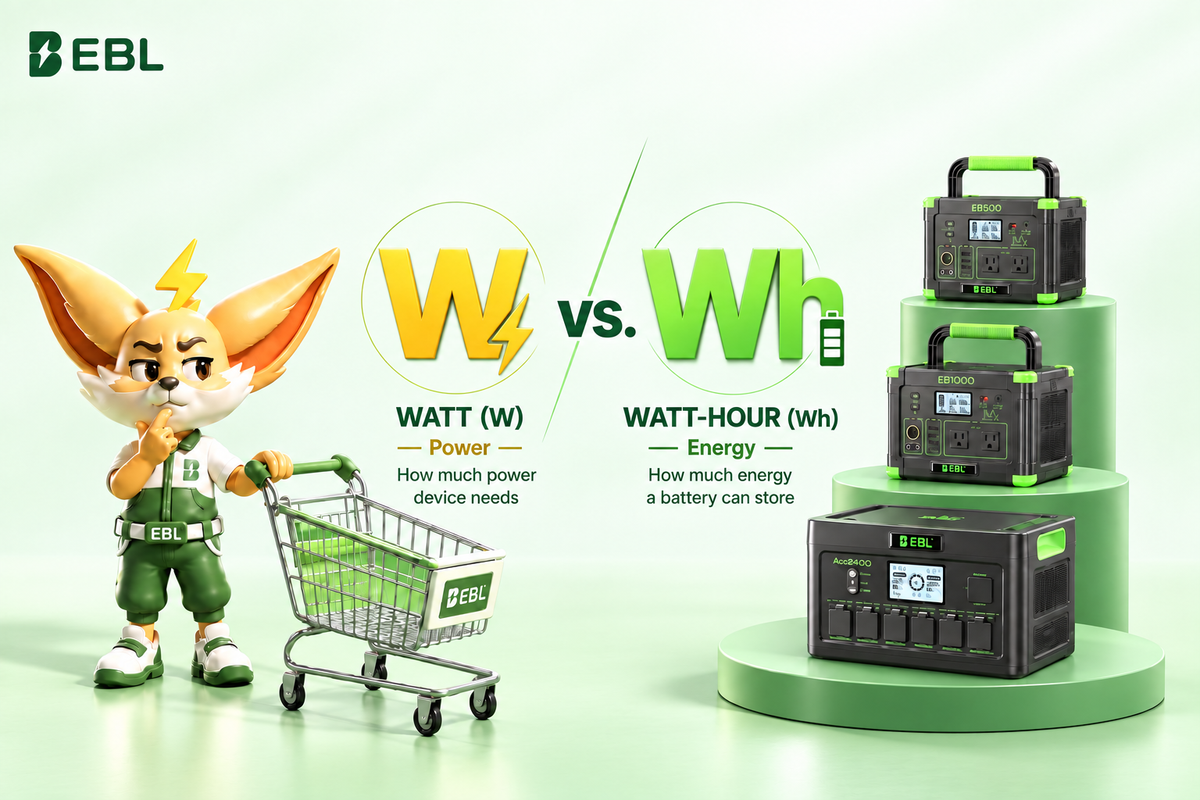
Next, look at battery capacity in watt-hours (Wh). Wattage tells you what a power station can run, while watt-hours help estimate how long it can run it.
| Use Case | Recommended Power Station |
|---|---|
| Camping and small electronics | 500W class |
| RV travel and medium-power devices | 1000W class |
| Home backup and high-power appliances | 2400W class |
These are starting points rather than strict rules. Your ideal power station depends on actual device wattage, startup surge requirements, battery capacity, and required runtime.
Understanding Watts and Watt-Hours
What Does Wattage Mean?
Watts (W) measure the rate at which an electrical device consumes power. A laptop may require several dozen watts, while appliances such as microwaves, coffee makers, heaters, and hair dryers can require well over 1,000 watts.
The first question is: Can the power station provide enough continuous output for my device?
What Does Wh Capacity Mean?
Watt-hours (Wh) describe the amount of energy stored in a battery. A 100W device running for 1 hour uses about 100Wh in a simplified calculation; running it for 5 hours uses about 500Wh.
Why Both Numbers Matter
| Your Question | What to Check |
|---|---|
| Can it run my device? | Continuous output wattage (W) |
| How long can it run my device? | Battery capacity (Wh) |
| Can it handle startup power? | Peak or surge output |
| Can I recharge away from the grid? | Solar, AC, and car charging options |
Watts = how much power you can use at once.
Watt-hours = how much stored energy you have.
Portable Power Station Device Power Table
Actual power consumption varies by model, operating mode, and manufacturer. Check your device's label or owner's manual before making a final sizing decision.
| Device | Typical Power Range* | Suggested Power Station |
|---|---|---|
| Smartphone | 5–20W | 500W |
| Tablet | 10–30W | 500W |
| Laptop | 30–100W | 500W |
| LED Lights | 5–30W | 500W |
| Wi-Fi Router | 10–30W | 500W |
| Fan | 20–100W | 500W |
| Portable Refrigerator | 40–100W+ | 500W–1000W |
| CPAP Machine | 30–100W+ | 500W–1000W |
| TV | 50–200W | 500W–1000W |
| Coffee Maker | 800–1500W+ | 1000W–2400W |
| Microwave | 1000–1500W+ | 2400W |
| Hair Dryer | 1200–1800W+ | 2400W |
| Electric Heater | 1000–1500W+ | 2400W |
| Power Tools | 500–1500W+ | 1000W–2400W |
*General planning ranges only. Use actual device wattage whenever possible.
Don't Forget Startup Power
Some appliances use significantly more power for a short period when motors or compressors start. This can matter for refrigerators, freezers, pumps, power tools, and other motor-driven equipment. Choosing a power station with output headroom is generally more flexible than operating continuously at the maximum rating.
How to Calculate Power Station Runtime
Simple Runtime Formula
A practical estimate for AC-powered devices is:
Runtime (hours) ≈ Battery Capacity (Wh) × 0.85 ÷ Device Power (W)
The 0.85 factor is a planning assumption for conversion and system losses. Actual runtime can vary with the device, operating conditions, battery condition, temperature, and conversion efficiency.
Example: Running a 60W Laptop
Using an approximately 519Wh battery:
519Wh × 0.85 ÷ 60W ≈ 7.4 hours
Example: Running a 100W Device
For a 100W device and a 519Wh battery:
519Wh × 0.85 ÷ 100W ≈ 4.4 hours
For a 999Wh battery:
999Wh × 0.85 ÷ 100W ≈ 8.5 hours
For an 1843.2Wh battery:
1843.2Wh × 0.85 ÷ 100W ≈ 15.7 hours
A higher-wattage power station does not automatically provide longer runtime. Battery capacity also matters.
Example: Running Multiple Devices
Imagine a camping setup using a 60W laptop, 40W fan, 20W LED lights, and 20W router.
60W + 40W + 20W + 20W = 140W total load
For five hours:
140W × 5 hours = 700Wh
Allowing for conversion losses:
700Wh ÷ 0.85 ≈ 824Wh
In this scenario, a power station around the 800–1000Wh class would be a more practical starting point than a roughly 500Wh battery if you need all four devices to run for the full five hours.
How to Choose the Right Power Station Capacity
The best answer to "how big of a power station do I need?" depends on your actual use case.
500W Power Station: Camping and Small Electronics
A 500W power station is a practical choice for smaller electronics and low-to-medium power devices such as phones, laptops, LED lighting, cameras, fans, and some small refrigerators.
The EBL 500W Portable Power Station provides 500W AC output and 519.48Wh capacity, making it a practical option for camping, road trips, outdoor adventures, and basic emergency power needs.
Best fit: casual camping, road trips, electronics, lighting, and smaller loads.
1000W Power Station: RV and Medium-Power Devices
A 1000W power station provides more output headroom for combinations of laptops, lights, routers, fans, portable refrigerators, entertainment equipment, and other medium-power devices, depending on actual requirements.
The EBL Voyager 1000 Portable Power Station provides 1000W rated output and 999Wh capacity, making it a useful middle-ground option for camping, RV travel, power outages, and off-grid use.
Best fit: RV trips, extended camping, medium-power devices, and broader emergency backup.
2400W Power Station: Home Backup and High-Power Appliances
A 2400W power station is better suited to applications where you need considerably more output headroom, including refrigerators, microwave ovens, coffee makers, power tools, electric heaters, and other higher-power household equipment, subject to actual device requirements.
The EBL 2400W Portable Power Station combines 2400W continuous output with 1843.2Wh battery capacity and up to 4800W peak output.
Best fit: home emergency backup, high-power appliances, demanding RV setups, job sites, and off-grid applications.
What Size Power Station Do You Need for Different Situations?
Camping
For basic camping, list every device you plan to bring and calculate both total simultaneous wattage and total daily energy use. A 500W class station can often work for electronics and smaller loads, while higher capacity may be needed for longer trips.

RV Travel
RV users often operate several devices throughout the day. A 1000W class power station can provide a useful balance for mixed loads, but high-power appliances should be checked individually.

Emergency Backup
For home emergencies, identify essential loads first, such as a refrigerator, communication devices, lighting, and essential electronics. Then calculate total wattage and desired runtime. A larger model may be appropriate when the required energy and output exceed what a smaller station can provide.

Off-Grid Use
For off-grid applications, consider both stored energy and recharge capability. Solar charging can help replenish the battery when grid power is unavailable. Match daily energy consumption with battery capacity and realistic daily solar generation.
A Simple Power Station Sizing Model
Step 1: Add Your Simultaneous Wattage
Example: Laptop 60W + Fan 40W + Lights 20W + Router 20W = 140W total load.
Step 2: Estimate Your Energy Requirement
If those devices run for five hours: 140W × 5 hours = 700Wh.
Step 3: Add a Practical Margin
Allow for conversion losses, changing device loads, startup surges, and future needs rather than selecting a battery that exactly matches the theoretical number.
| Your Main Need | Recommended Starting Point |
|---|---|
| Small electronics and casual camping | 500W class |
| RV and mixed medium loads | 1000W class |
| Home backup and high-power loads | 2400W class |
Recommended EBL Power Stations
| EBL Model | Output | Battery Capacity | Recommended For |
|---|---|---|---|
| EBL 500W Portable Power Station | 500W | 519.48Wh | Camping, electronics, small loads |
| EBL Voyager 1000 | 1000W | 999Wh | RV, medium-power devices, longer trips |
| EBL 2400W Portable Power Station | 2400W | 1843.2Wh | Home backup, emergency power, high-power appliances |
Frequently Asked Questions
Can a portable power station run a refrigerator?
Yes, provided the power station can handle both the refrigerator's running wattage and startup surge. Check the refrigerator's specifications before choosing a power station.
How many watts should a portable power station have?
A useful starting point is 500W for basic camping and electronics, 1000W for RV use and medium-power devices, and 2400W for higher-power appliances and home backup.
How long will a 1000W power station last?
The 1000W rating describes output capability, not runtime. Runtime depends primarily on battery capacity and device power consumption.
Can I charge a power station with solar panels?
Yes. EBL power stations support solar charging, although supported solar input varies by model.
Is a 500W power station enough for camping?
For many basic camping setups, yes. A 500W class station can be practical for phones, laptops, lights, fans, cameras, and other smaller loads.
Is a 1000W power station enough for an RV?
It can be, depending on the appliances you plan to run. A 1000W station offers more headroom than a 500W model for mixed loads, but high-power appliances may require more output.
What's more important: watts or watt-hours?
Both are important. Watts determine whether the power station can run the device. Watt-hours help determine how long the stored energy can last.
How do I know what size power station I need?
List the devices you want to run, add their simultaneous wattage, check startup surge, estimate required runtime, and choose a power station with sufficient output and battery capacity.
Find the Right EBL Power Station for Your Needs
Start with your total device wattage and the runtime you need. Choose the EBL 500W Portable Power Station for lightweight camping and everyday electronics, the EBL Voyager 1000 for RV and medium-power use, or the EBL 2400W Portable Power Station for higher-power appliances and home backup.
Explore EBL Portable Power Stations and find the right power level for your next trip, emergency, or off-grid setup.

Dejar un comentario
Todos los comentarios se revisan antes de su publicación.
Este sitio está protegido por hCaptcha y se aplican la Política de privacidad de hCaptcha y los Términos del servicio.