
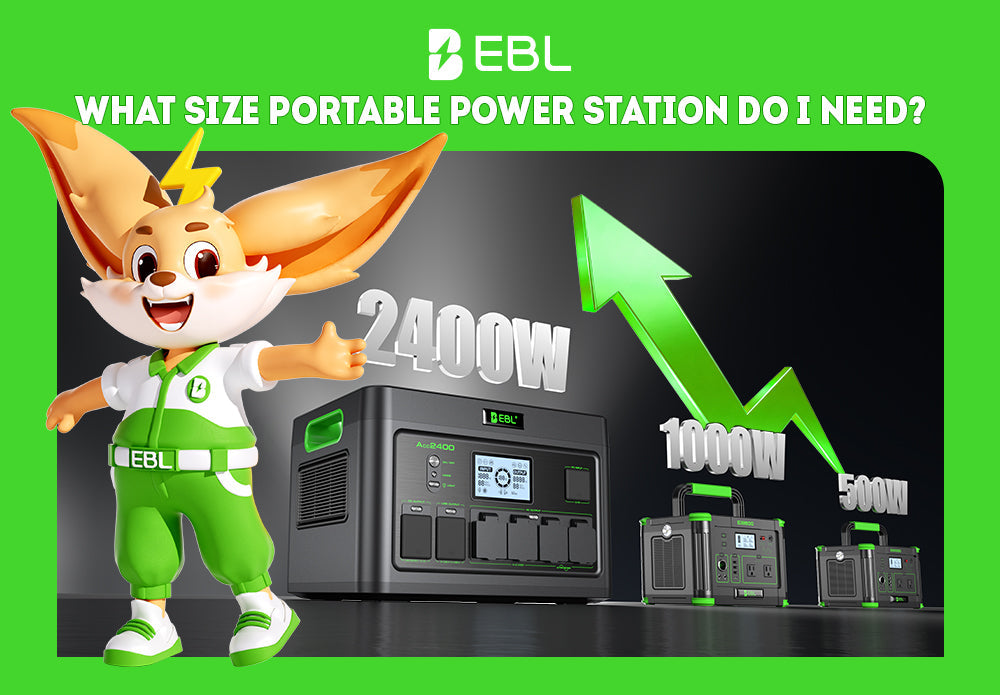
Most campers need a 500W portable power station, most RV users are better served by 1000W, and home-backup users should consider 2400W. The right size depends on two numbers: the highest wattage your devices draw at once and the watt-hours needed for your desired runtime. Add 20–25% headroom for startup surges and conversion losses.
What Size Portable Power Station Do You Need?
Choose a power station by matching its continuous output in watts (W) to your simultaneous device load, then matching its battery capacity in watt-hours (Wh) to how long you need those devices to run. Output determines what you can power; capacity determines how long you can power it.
| Power station size | Best fit | Typical devices | Main limitation |
|---|---|---|---|
| 500W | Camping, day trips, mobile work | Phones, laptops, lights, camera batteries, fan, small TV | Usually not suitable for high-heat appliances |
| 1000W | RV weekends, tailgating, short outages | Portable fridge, CPAP, TV, laptops, small kitchen appliances | Runtime falls quickly when several appliances run together |
| 2400W | Home backup, longer RV stays, off-grid use | Refrigerator, microwave, coffee maker, power tools, multiple essentials | Higher weight, cost and recharge demand |
Quick decision rule: choose 500W if every device stays below 500W and your priority is portability; choose 1000W when refrigeration or several medium-load devices matter; choose 2400W when you need household appliances, higher startup loads or longer backup coverage.
500W Portable Power Station: Best for Camping
A 500W unit is usually enough for charging electronics and running efficient campsite essentials. It is the most portable choice in this comparison and avoids paying for output you may never use. A realistic campsite load might include a 60W laptop, 10W phone charger, 12W LED light and 35W fan—a combined load of about 117W.
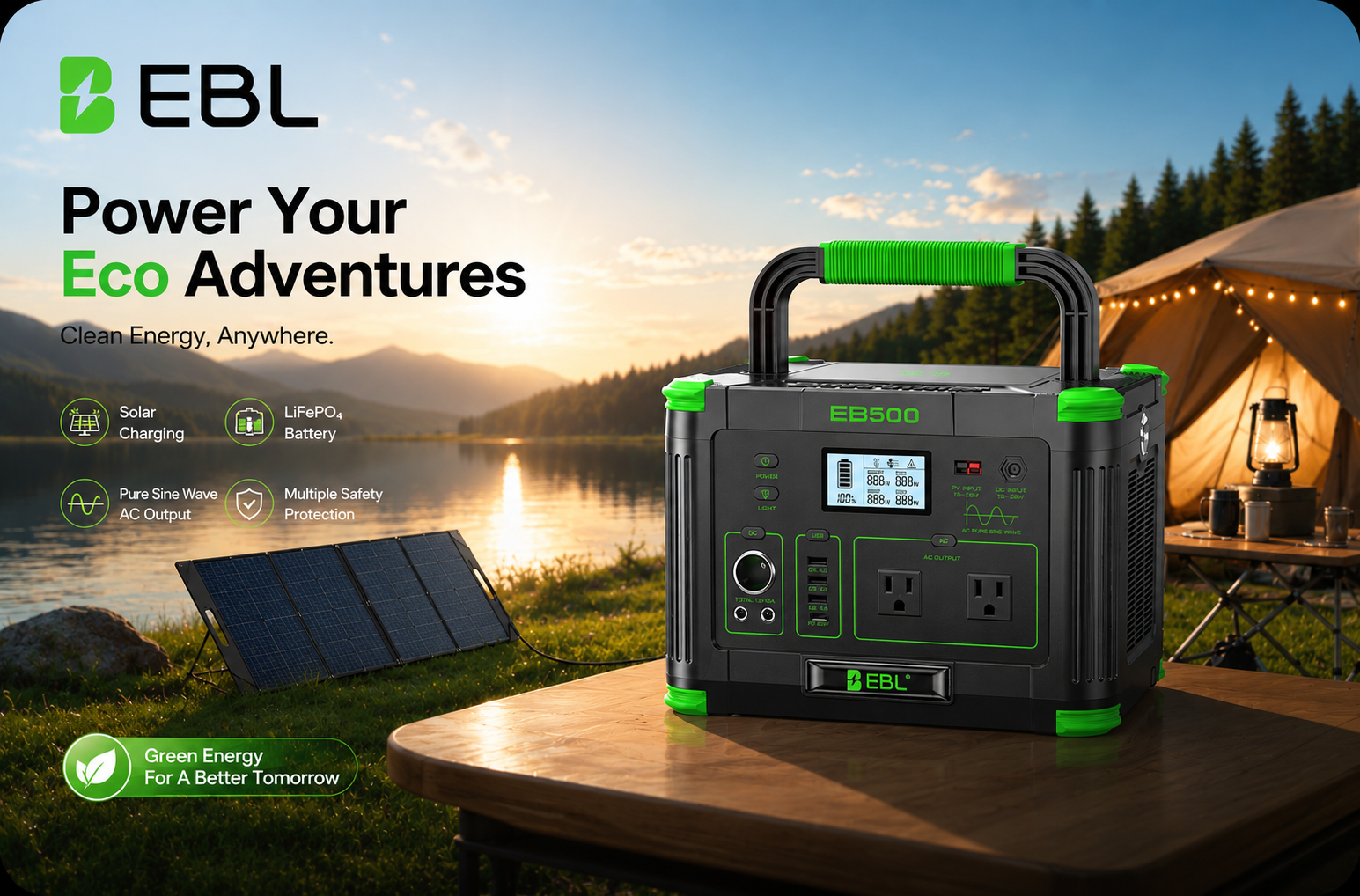
For this use case, the EBL 500W Portable Power Station is designed for portable outdoor power. Check each appliance label before connecting devices such as kettles, heaters, hair dryers or hot plates, because their heating elements often exceed 500W.
1000W Portable Power Station: Best for RV Travel
A 1000W model provides useful headroom for an RV refrigerator, CPAP machine, television, lights and device charging. It is also a practical middle ground for short home outages because it can support more essentials without the size of a high-output backup unit.
The EBL 1000W Portable Power Station pairs 1000W output with a 999Wh battery. That combination is suitable when the connected load remains within the rated output and the expected runtime fits the battery budget.
2400W Portable Power Station: Best for Home Backup
A 2400W power station is the strongest fit when you need to run several household essentials or appliances with high starting demand. Refrigerators and tools can briefly draw far more power at startup than their normal running wattage, so extra output headroom matters.
The EBL 2400W Portable Power Station is positioned for robust home and outdoor loads. Its listed 1843.2Wh capacity gives substantially more energy than smaller portable models, but users should still prioritize essential circuits and avoid assuming every appliance can run simultaneously.
How to Calculate Your Power Requirements
Start with an appliance inventory. Read the wattage on each device label or power adapter, then record how many hours you expect to use it. If a label lists volts and amps instead of watts, use:
Watts = Volts × Amps
Next, calculate the load that may run at the same time:
Required output (W) = Sum of simultaneous device watts × 1.25
The 1.25 factor provides 25% operating headroom. It does not replace checking an appliance's startup or surge rating.
Runtime Formula
For a practical AC-powered estimate, use:
Estimated runtime (hours) = Battery capacity (Wh) × 0.85 ÷ Device load (W)
The 0.85 factor is a planning allowance for inverter and system losses. Actual runtime changes with temperature, battery age, inverter efficiency, standby consumption and appliance cycling.
| Device | Planning wattage | Energy for stated use | Suggested output class |
|---|---|---|---|
| Phone charger | 10W | 30Wh for 3 hours | 500W |
| Laptop | 60W | 240Wh for 4 hours | 500W |
| CPAP without heated humidifier | 40W | 320Wh for 8 hours | 500W+ |
| Portable refrigerator | 60W average* | 720Wh for 12 hours | 1000W+ |
| Microwave | 1200W | 200Wh for 10 minutes | 2400W |
| Coffee maker | 1000W | 167Wh for 10 minutes | 2400W |
*Refrigerator draw varies widely and cycles on and off. Measure your actual unit with a plug-in power meter when possible.
500W vs 1000W vs 2400W: Side-by-Side Comparison
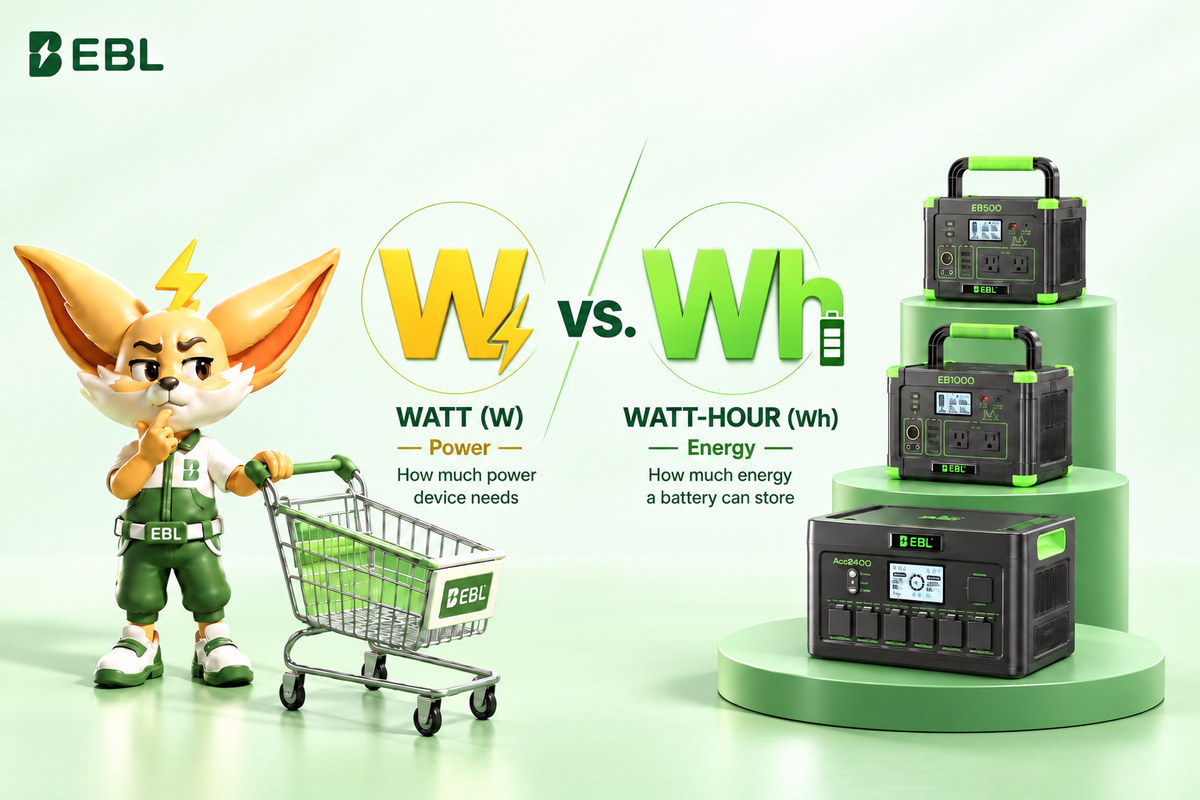
The wattage printed on a power station is its output ceiling, not its battery capacity. A 1000W power station does not automatically run a 100W device for ten hours; runtime depends on the battery's Wh rating and conversion losses.
| Decision factor | 500W | 1000W | 2400W |
|---|---|---|---|
| Portability | Best | Balanced | Lowest |
| Electronics and lights | Excellent | Excellent | Excellent |
| Refrigeration | Only if startup draw fits | Good fit for many portable units | Strong fit with headroom |
| Heating appliances | Usually unsuitable | Limited; check exact load | Better fit within rating |
| Home outage coverage | Communications and lighting | Selected essentials | Multiple essentials |
| Solar pairing | 100W panel for portability | 100W or 200W depending on recharge window | 200W or more input may be preferable; check model limits |
Best Size for Camping, RV and Home Backup
Original Use Case 1: A 24-Hour Camping Energy Budget
Suppose two people need four phone charges (about 48Wh), six hours of LED lighting at 12W (72Wh), four laptop hours at 60W (240Wh) and four fan hours at 35W (140Wh). The total device energy is about 500Wh. Because usable AC energy is lower than the battery's nameplate capacity, this plan is near the upper edge of many 500W-class systems. Reduce laptop time, recharge with solar during the day or move up a class if all loads are essential.
Original Use Case 2: An Overnight RV Load Check
Consider an eight-hour CPAP load at 40W (320Wh), a refrigerator budget of 480Wh, lights and phones totaling 100Wh, and a laptop budget of 120Wh. Total demand is approximately 1,020Wh. A 999Wh battery would be tight after losses, so the decision is not simply "1000W output equals enough." The better plan is to measure the refrigerator, disable optional heated CPAP features if medically appropriate, add daytime solar charging or choose more stored energy.
Original Use Case 3: A Four-Hour Home Outage Plan
Assume a refrigerator averages 100W over time (400Wh), a router uses 12W (48Wh), four LED bulbs total 36W (144Wh), two phones require 30Wh and a 1000W coffee maker runs for six minutes (100Wh). Planned energy is about 722Wh, while simultaneous output may briefly exceed 1,100W when the coffee maker and refrigerator overlap. A 2400W model provides better output headroom; staggering the coffee maker lowers the peak load and preserves energy.
EBL Model Recommendation
Use this three-step model:
- List must-run devices. Separate essential loads from optional comfort loads.
- Pass both tests. The station must handle simultaneous watts, including startup demand, and provide enough Wh for the planned runtime.
- Add a margin. Choose at least 20–25% output headroom and plan for conversion losses.
- Choose EBL 500W for phones, laptops, lights, cameras, fans and compact camping loads.
- Choose EBL 1000W for RV essentials, portable refrigeration, CPAP use and short outage support.
- Choose EBL 2400W for home backup, larger appliances, tools and multi-device loads requiring higher surge headroom.
If your calculations land within 10–15% of a model's output or energy limit, move up a class or reduce the load. Operating at the edge leaves little room for startup surges, colder weather or an unplanned extra device.
How Solar Panels Affect the Size Decision
A solar panel does not increase a power station's maximum AC output. It replenishes stored energy. A 100W solar panel suits portable, low-energy setups, while a 200W panel can shorten recharge time when conditions and the station's solar input allow it.
Use this planning formula:
Estimated solar recharge time = Battery capacity (Wh) ÷ (Panel watts × real-world solar factor)
A planning factor of 0.60–0.80 is reasonable for variable sun, panel angle, temperature and conversion losses. Solar results are weather-dependent; confirm the station's voltage, connector and maximum input specifications before pairing equipment.
Common Sizing Mistakes to Avoid
- Confusing watts with watt-hours: watts describe output; watt-hours describe stored energy.
- Ignoring startup surge: compressors, pumps and tools may spike above their running wattage.
- Adding every device: calculate the devices that will actually run at the same time.
- Using nameplate capacity as fully usable AC energy: account for conversion losses.
- Buying without an energy budget: a short high-power task may use less energy than a low-power device running all night.
FAQ
Can a portable power station run a refrigerator?
Yes, if the station's continuous and surge output exceed the refrigerator's running and startup draw. Runtime depends on battery capacity, ambient temperature and how often the compressor cycles. Measure the refrigerator over 24 hours for the best estimate.
How long will a 1000W power station last?
"1000W" describes output, not runtime. For a model with a 999Wh battery, a constant 100W AC load is approximately 999 × 0.85 ÷ 100 = 8.5 hours in a planning calculation. Actual results vary.
Is a 500W power station enough for camping?
Usually, yes, for phones, laptops, lights, cameras and a fan. It may not be enough for electric cooking or heating appliances. Add the simultaneous watts and total Wh required before deciding.
What can a 2400W portable power station run?
A 2400W unit can support many household essentials and selected high-power appliances as long as their combined continuous and startup demand remains within the model's ratings. Avoid assuming it can power an entire home at once.
Can I charge a portable power station with solar panels?
Yes. Use a compatible panel whose voltage, connector and wattage fall within the station's solar input limits. A 100W panel favors portability; a 200W panel can recharge faster in suitable sunlight.
Should I buy a larger power station than my calculation requires?
Allowing 20–25% output headroom is sensible. Move up a class when your load is close to the limit, includes compressor or motor startup, or must keep running through uncertain conditions.
Do I need 1000W or 2400W for home backup?
Choose 1000W for a short list of low- to medium-power essentials. Choose 2400W when you need higher-startup appliances, multiple simultaneous loads or more stored energy. A written outage load plan makes the decision clearer.
Ready to choose? Add up your simultaneous watts, estimate your required Wh, then compare the EBL 500W, EBL 1000W and EBL 2400W portable power stations for the setup that fits your real load.

Dejar un comentario
Todos los comentarios se revisan antes de su publicación.
Este sitio está protegido por hCaptcha y se aplican la Política de privacidad de hCaptcha y los Términos del servicio.