
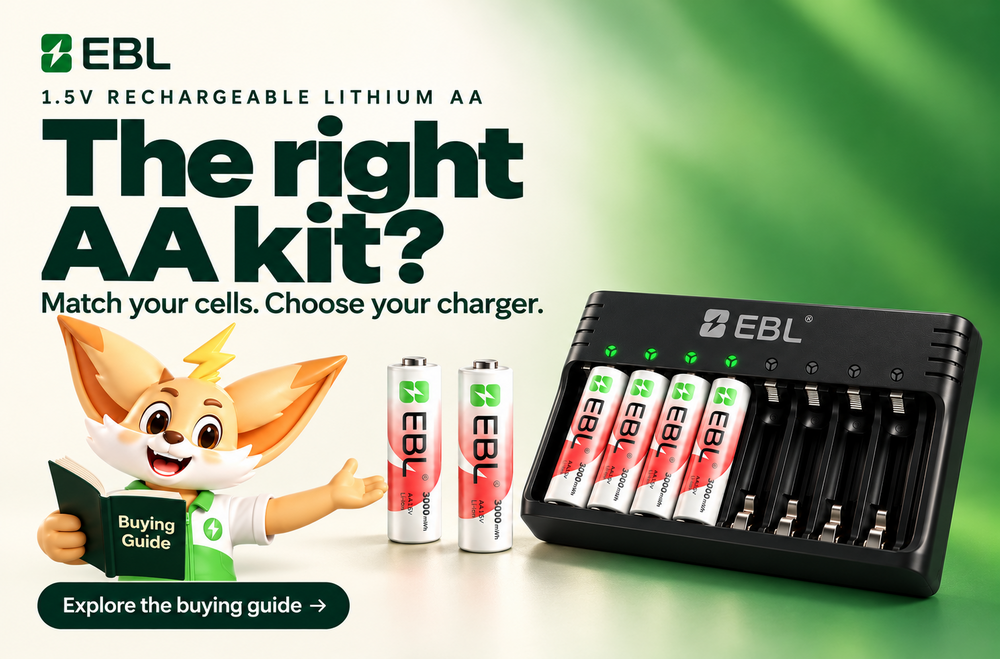
Rechargeable lithium AA batteries with charger are a practical choice when your device accepts rechargeable 1.5V lithium cells and you need a matching charging system. Choose a kit by checking the battery type, charger compatibility, independent charging slots, and how many spare cells you need. Buying batteries and a charger together simplifies the charging decision, but you still need to confirm that your device supports the batteries.
Why Buy Batteries and a Charger Together?
A battery-and-charger kit pairs rechargeable cells with the charging equipment intended for them. This is especially useful for 1.5V lithium AA batteries because a charger labeled “AA” or “Li-ion” does not automatically support this battery type. A kit can simplify your first purchase and give you one charging routine to follow.
A rechargeable lithium AA battery is an AA-size battery that uses lithium-ion chemistry and electronics to provide a regulated 1.5V output. It is different from a single-use lithium AA battery, which must never be recharged.
Use this three-way buying decision
- Starting from scratch: choose a battery-and-charger kit after confirming device compatibility.
- Already own a charger: buy cells separately only if its instructions explicitly support the exact battery model.
- Your device specifies another chemistry: follow that requirement before considering any kit.
For a broader explanation of battery types, see our 1.5V rechargeable AA lithium buying guide. If you rarely replace batteries, our rechargeable versus disposable battery comparison can help you decide whether switching makes sense.
What Does Charger Compatibility Actually Mean?
Charger compatibility means more than fitting into a slot: the charger must support the battery’s chemistry, charging requirements, and specific design. Regulated 1.5V lithium AA cells are different from 1.2V NiMH AA cells and higher-voltage 14500 lithium-ion cells. Read the supported-battery list before inserting a cell, even if the charger is described as universal.
| Label or feature | What to check before charging |
|---|---|
| AA/AAA slots | Size support alone does not establish chemistry compatibility. |
| NiMH or NiCd support | Does not by itself cover rechargeable 1.5V lithium AA batteries. |
| Li-ion support | Look specifically for regulated 1.5V AA support and approval for your cells. |
| USB-C input | Identifies how the charger receives power, not which batteries it accepts. |
| Multi-chemistry support | Follow the listed battery types and any restrictions on charging them together. |

Check the power source, too
For the featured EBL kit, USB-C is the input on the charger; it does not mean each AA cell has its own USB-C port. Follow the charger label for the required power supply, and check whether a wall adapter is included before ordering. A cable and a wall adapter are separate items.
Never put primary lithium or standard alkaline batteries into a charger. Do not charge cells with torn wrappers, leakage, swelling, or other damage.
Why Do Independent Charging Slots Matter?
Independent slots allow supported batteries to charge individually instead of requiring fixed pairs. That makes a charger easier to use when one device takes three batteries and another takes two. The feature describes how the slots operate; it does not expand the charger’s approved battery list or make different chemistries interchangeable inside a device.
EBL lists independent slots and support for one to eight batteries for the charger in this kit. You do not need to wait until all eight cells are ready for charging. Check the included instructions for indicator meanings rather than assuming every charger uses the same colors.
Plan your spare sets before choosing a pack
Use a simple count, based on devices that already pass the compatibility check:
Cells to buy = cells in regular use + one complete spare set for each device you want to swap immediately.
For example, two compatible controllers using two AA batteries each need four cells in service. Keeping one spare pair for each controller brings the total to eight. A compatible four-AA camera needs four in service plus four spare, also totaling eight. These are planning examples, not runtime tests or claims that every controller or camera accepts lithium AA batteries.
Keep each device’s cells together as a matched set. Store charged spares in a battery case with protected terminals, and keep used cells separate so you can identify which set needs charging.

Which Devices Are a Good Fit for 1.5V Lithium AA?
Devices that permit rechargeable lithium AA batteries and benefit from regulated 1.5V output are the strongest candidates. Examples can include compatible cameras, toys, and game controllers. The device manual remains the deciding factor: AA dimensions and a 1.5V label alone do not confirm acceptable chemistry, current demand, or reliable low-battery warnings.
| Device | Why consider a kit? | What must match? |
|---|---|---|
| Game controller | A spare pair can simplify battery swaps. | AA size, approved rechargeable chemistry, and charging instructions. |
| AA-powered camera or toy | A complete spare set can reduce interruptions. | Battery type plus continuous and peak current requirements. |
| Remote or wireless accessory | Rechargeable sets can suit frequent battery changes. | Approved chemistry and how the device reports remaining charge. |
| Smart lock or security camera | Consider only when the specific model allows these cells. | Required chemistry, operating conditions, and low-battery warning behavior. |
Does 1.5V mean better than 1.2V NiMH?
Regulated lithium AA batteries hold their output near 1.5V through much of a discharge. NiMH AA batteries have a nominal voltage of 1.2V and work well in devices designed to accept them. The higher number is useful only when it suits the device; it does not guarantee longer runtime or better performance.
Some battery indicators estimate remaining charge from voltage. A regulated output can make that estimate less informative. For a device that relies on a low-battery warning, check the manufacturer’s guidance before switching chemistry.
Is the EBL AA Battery and Charger Kit Right for You?
The EBL 8-AA lithium battery and charger kit is worth considering if your devices accept rechargeable 1.5V lithium AA cells and you want an included charger. The eight-cell bundle also fits the spare-set examples above. Choose it for verified device needs and a manageable charging routine, rather than assuming that a kit solves every compatibility question.
| Feature | Listed specification | Buying takeaway |
|---|---|---|
| Bundle | 8 AA batteries + 1 charger | Select the 8-AA variant, not an AAA or mixed bundle. |
| Battery output | 1.5V regulated | Check device approval for rechargeable lithium AA. |
| Energy rating | 3000mWh per AA battery | This equals 3Wh; it is not a 3000mAh rating. |
| Charging slots | Independent; supports 1–8 batteries | Charge the number of supported cells you need. |
| Charger input | USB Type-C | Follow the charger’s power-supply instructions. |
Read energy ratings without guessing runtime
Watt-hours (Wh) = milli-watt-hours (mWh) ÷ 1,000. The listed 3000mWh rating therefore equals 3Wh per cell. If comparing a rating in mAh, use Wh = voltage × mAh ÷ 1,000, making sure the voltage and capacity refer to the same measurement basis.
Do not compare mAh numbers alone across chemistries. Rated energy also does not establish usable energy in your device: conversion losses, discharge current, temperature, cutoff voltage, and usage all affect runtime. This guide makes no fixed runtime claim.
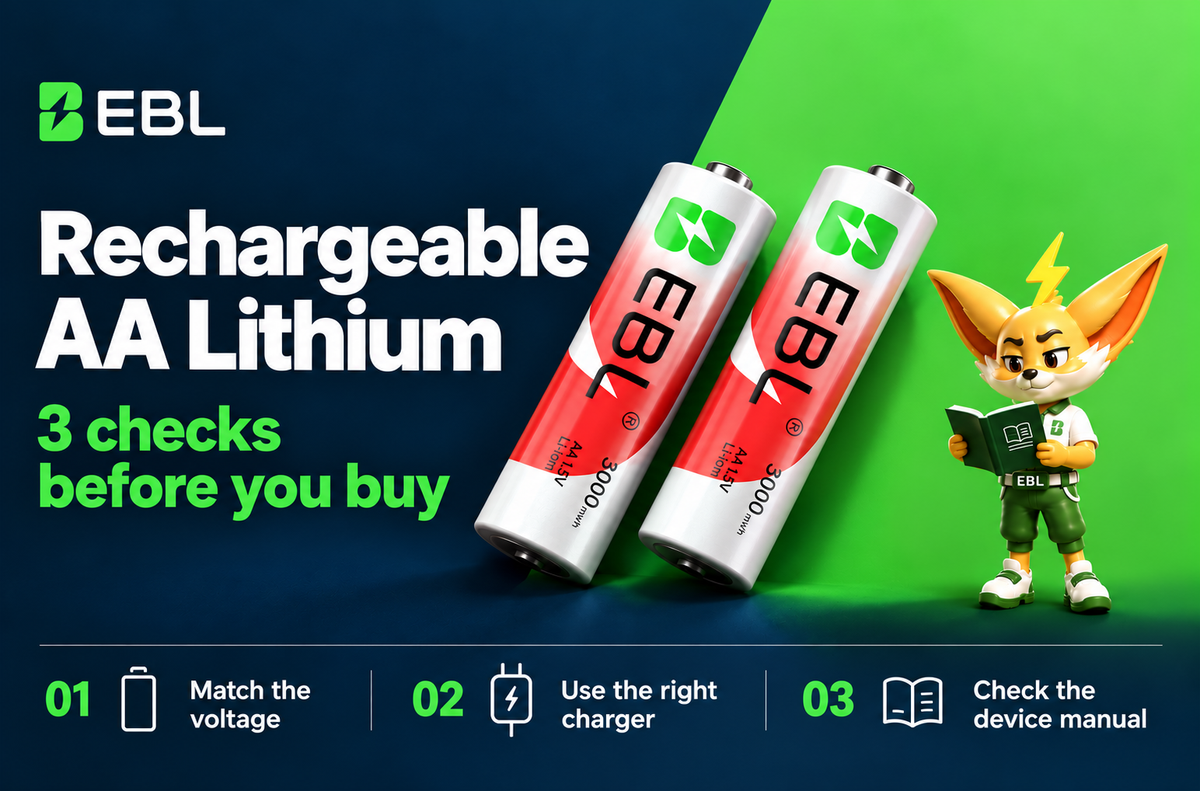
Your final buying checklist
- Confirm AA size and the required battery count in the device manual.
- Confirm that rechargeable lithium chemistry and regulated 1.5V output are allowed.
- Check current requirements and any low-battery indicator limitations.
- Choose a charger approved for the exact cells and a suitable power source.
- Count complete working and spare sets; verify the selected bundle at checkout.
If the manual does not settle compatibility, ask the device manufacturer with your model number before purchasing. Use the specified alternative when rechargeable lithium cells are not approved.
FAQ
Can I charge lithium AA batteries in a regular AA charger?
Only if the charger explicitly supports the exact rechargeable 1.5V lithium AA model. An AA slot or a generic Li-ion label is not enough. A NiMH-only charger is unsuitable. Check both sets of instructions, or use the charging equipment supplied for the batteries.
Are all lithium AA batteries rechargeable?
No. Primary lithium AA batteries are single-use, while rechargeable lithium AA models are designed to be charged again. Both can carry a 1.5V label. Look for an explicit rechargeable marking and the manufacturer’s charging instructions before putting any lithium AA battery into a charger.
Can I charge just one battery in an eight-slot charger?
Yes, if the charger has independent slots and its instructions permit single-cell charging. EBL lists support for one to eight batteries for this kit’s charger. You do not have to fill every slot, but each battery still needs to be a supported rechargeable model.
Does a USB-C charger mean the batteries charge through USB-C?
No. In this EBL kit, the batteries charge in the charger’s slots, and USB-C supplies power to the charger. Other battery models may have built-in USB ports, but that is a different design. Follow the instructions for the exact cells and charger you purchase.
Will these batteries work in any device that uses AA batteries?
No. AA describes a size category, not universal compatibility. Check the required chemistry, voltage, current demand, and low-battery behavior. A device that specifies primary lithium or alkaline batteries should use that type unless its manufacturer also approves rechargeable lithium AA cells for the specific model.
How many rechargeable AA batteries should I buy?
Count the cells in compatible devices you use regularly, then add a complete spare set for each device you want to swap immediately. Two two-AA devices plus a spare pair for each require eight cells. Keep sets matched instead of mixing different chemistries, ages, or charge levels.
Ready to build your charging routine? Check your device manual, then view the EBL 8-AA lithium battery and charger kit and confirm the selected bundle.


Dejar un comentario
Todos los comentarios se revisan antes de su publicación.
Este sitio está protegido por hCaptcha y se aplican la Política de privacidad de hCaptcha y los Términos del servicio.