
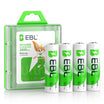
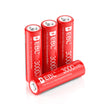
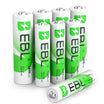
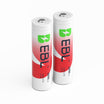
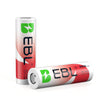
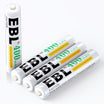
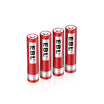
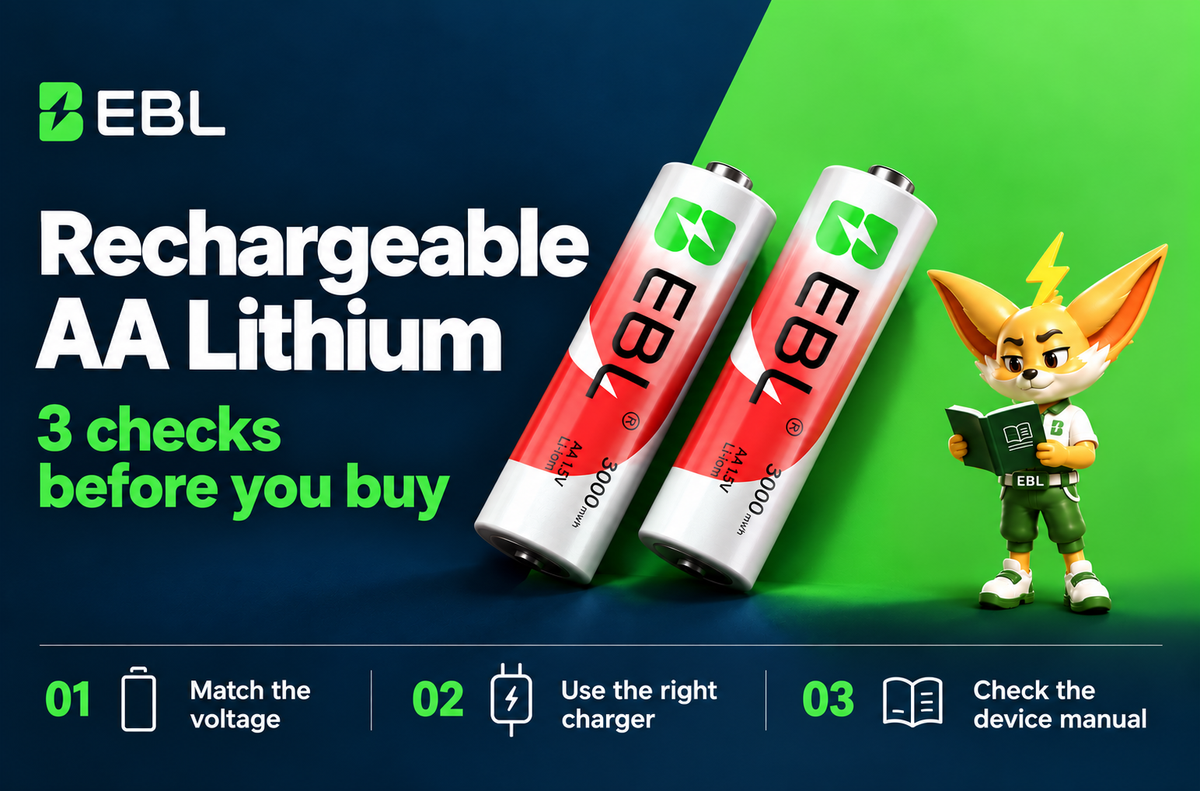
Rechargeable AA lithium batteries suit devices that accept rechargeable lithium chemistry and regulated 1.5V output. They need a compatible charging system and are different from single-use lithium AA batteries. Before choosing a set, confirm three things: your device allows this battery type, the voltage matches, and the charger supports the exact cells. Constant 1.5V can help voltage-sensitive devices, but it does not guarantee longer runtime.
What Are Rechargeable AA Lithium Batteries?
A rechargeable 1.5V lithium AA battery uses a lithium-ion cell and internal circuitry to regulate its output. “AA” describes the size category, not the chemistry. Primary lithium AA batteries may also be labeled 1.5V, but they are single-use and must never be placed in a charger.
| Battery type | Output | Rechargeable? | Charging requirement |
|---|---|---|---|
| Regulated lithium-ion AA | 1.5V | Yes | Charger approved for the exact 1.5V lithium model |
| NiMH AA | 1.2V nominal | Yes | Compatible NiMH charger |
| Primary lithium AA | 1.5V nominal | No | Do not recharge |
| Standard alkaline AA | 1.5V nominal | No | Do not recharge |
Look for the word rechargeable and the model’s charging instructions. A similar-looking 3.6V or 3.7V 14500 cell is not a substitute for a 1.5V AA unless the device explicitly supports it.
For related choices, see our rechargeable versus disposable battery comparison and introduction to 1.5V lithium AA and AAA batteries.
When Does Constant 1.5V Help?
Regulated 1.5V output can help a compatible device that needs a higher operating voltage than a typical 1.2V NiMH cell supplies. NiMH also has a relatively steady discharge plateau and works well in many devices. Choose according to the device’s requirements, rather than assuming higher voltage always means better performance.
For example, a compatible motorized toy may benefit from a steadier supply as its batteries discharge. However, voltage regulation does not remove current limits: the battery must still support the motor’s startup demand.
A regulated output can also affect devices that estimate remaining charge from voltage. Their battery icons may give less useful warning before replacement is needed. Check the device instructions rather than relying on the icon alone.
- Device permits rechargeable lithium and benefits from 1.5V: consider regulated lithium AA.
- Device supports or specifies 1.2V rechargeables: compatible NiMH is a practical option.
- Device requires alkaline or disposable lithium: use the specified type.

How Do You Compare Capacity and Runtime?
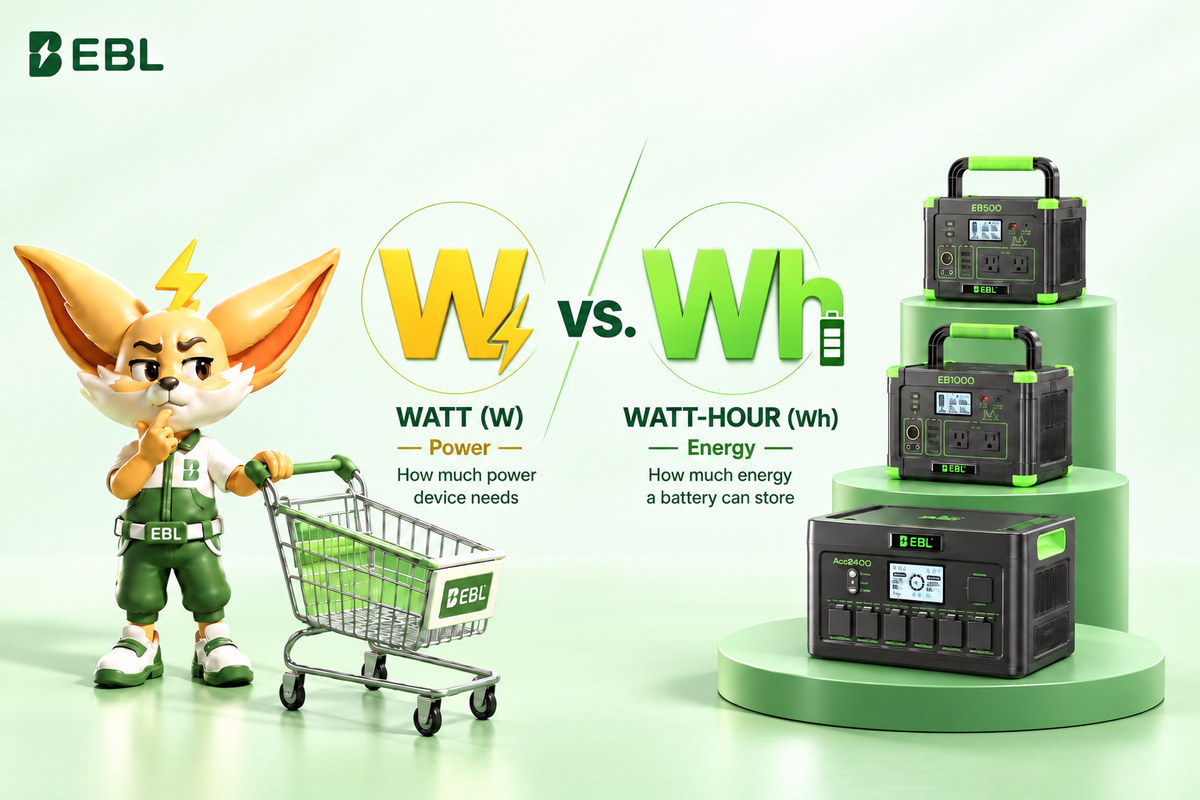
Compare energy in watt-hours, not just the mAh number. Milliamp-hours measure charge; milliwatt-hours measure energy. Different voltages and discharge conditions can make a direct mAh comparison misleading. Even equal energy ratings do not guarantee the same runtime, because a device may not use all the energy a battery stores.
Wh ≈ nominal voltage × capacity in Ah
Ah = mAh ÷ 1,000
Wh = mWh ÷ 1,000
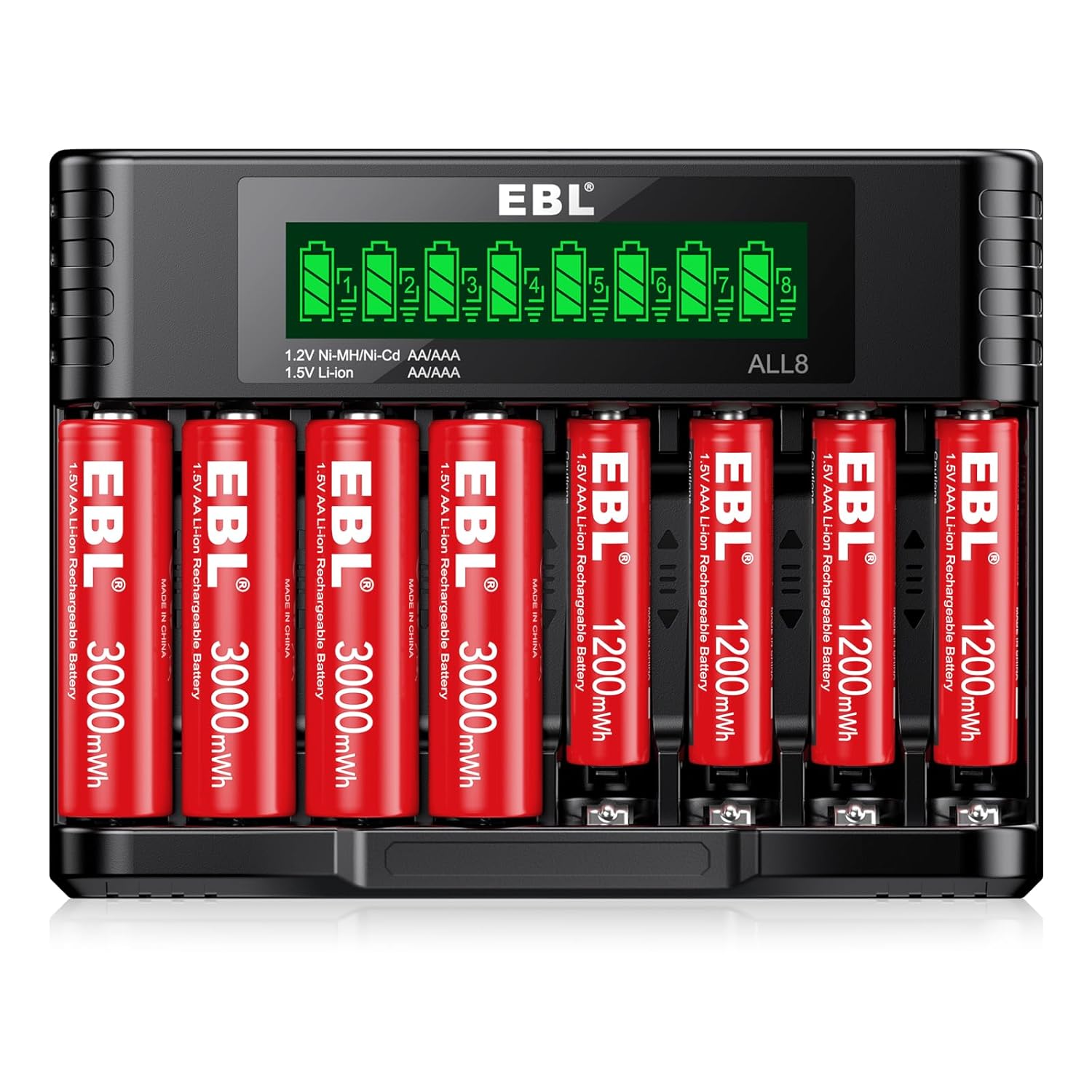
The AA cells in EBL’s MPCDQ8000AEB kit are listed at 3000mWh, or 3Wh of rated energy per cell. This does not mean 3000mAh. Confirm whether a rating describes internal stored energy or usable output before using it in a runtime calculation.
Estimated runtime = usable battery energy ÷ average device power. For example, a hypothetical set delivering 4Wh to a device averaging 0.5W would run for about 8 hours. This is an illustration, not an EBL test result.
Actual runtime depends on conversion efficiency, discharge current, temperature, device cutoff voltage, battery age, and usage. Use the whole set’s usable energy and a representative average power draw. A camera taking frequent flash photos will consume energy differently from the same camera sitting idle.
Which Charger Should You Use?
Choose a charger explicitly approved for the exact rechargeable 1.5V lithium AA model. A NiMH-only charger is unsuitable, and a general “Li-ion” label may refer to other voltages. Neither matching slot size nor matching brand is enough to confirm compatibility. Check the battery instructions alongside the charger’s supported battery types.
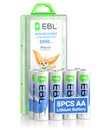
The EBL 8-AA lithium battery and charger kit provides a matched option for compatible devices. Its listing identifies USB-C input on the charger and support for 1.5V lithium-ion and 1.2V NiMH/NiCd AA/AAA batteries.
USB-C input refers to the charger, not a port on each cell. Batteries with built-in USB ports are a different design. Likewise, plugging a controller into USB does not establish that it can charge loose AA batteries.
Before charging, inspect cells for damaged wrappers, deformation, or leakage. Follow the specified power supply, polarity, and temperature limits. Charge in a dry location away from flammable materials, and stop using damaged cells. Never dismantle, modify, or attempt to revive them with improvised equipment.

Which Devices Are a Good Fit?
Frequently used cameras, controllers, and toys can be suitable applications when their manufacturers allow rechargeable 1.5V lithium AA batteries. The benefit is a reusable power supply with regulated voltage. Match the exact device model first, especially for locks, security cameras, and alarms whose chemistry requirements or battery monitoring may be restrictive.
- Game controllers: keep a matched spare set ready and use external charging unless in-device charging is explicitly supported.
- Digital cameras: check the approved battery list and any battery-type menu setting; carry spares in a case that protects their terminals.
- Motorized toys: confirm the battery can handle startup current as well as normal operation.
Security-camera exception: Blink’s guidance specifies non-rechargeable 1.5V lithium AA batteries for its relevant battery-powered cameras. Rechargeable lithium AA cells are not an approved substitute simply because their size and voltage match. Apply the same model-specific check to smart locks and alarms.
For approved applications, MPCDQ8000AEB includes eight AA cells rated at 3000mWh each and a charger. Select the 8-AA variant; the product page also offers other configurations. Our AA and AAA rechargeable battery buying guide provides a broader shortlist.
| Check | What to confirm |
|---|---|
| Device approval | The manual permits rechargeable 1.5V lithium AA batteries. |
| Size and fit | AA size, matching contacts, correct polarity, and no forced fit. |
| Current demand | The battery meets the device’s continuous and peak current requirements. |
| Charging | The exact battery model is supported by your charger. |
| Battery indicator | Any limitations of the device’s remaining-charge display are understood. |
| Use conditions | A matched set is used within the specified temperature limits. |
Use this checklist before ordering. If the manual does not answer a compatibility question, send the device manufacturer your model number and the proposed battery specification. Use a matched set rather than mixing different chemistries, ages, or charge states.
Frequently Asked Questions
Are all lithium AA batteries rechargeable?
No. Primary lithium AA batteries are single-use, while rechargeable lithium-ion AA batteries are designed to be charged again. Both may be labeled 1.5V. Identify the model and look for an explicit rechargeable label before charging; an AA shape or the word lithium alone is insufficient.
Can I use my existing AA charger?
Only if its instructions explicitly support the exact rechargeable 1.5V lithium AA battery. A NiMH-only charger is unsuitable. A multi-chemistry charger may work, but verify its supported models and voltages first. When replacing a lost charger, use the battery model number to request an approved replacement.
Does 3000mWh mean 3000mAh?
No. A 3000mWh rating equals 3Wh of energy. Milliamp-hours measure charge and require a specified voltage to estimate energy. Also check whether a regulated battery’s rating describes stored energy or delivered output. The rating alone cannot establish how long it will run your device.
Can these batteries work in a smart lock?
Only if the lock manufacturer permits rechargeable lithium AA batteries for that model. Some locks specify a particular chemistry or rely on its voltage profile for low-battery warnings. Check the manual before switching, even when the proposed battery has the same AA size and 1.5V label.
Can I mix lithium AA and NiMH batteries?
Use a matched set in the device instead of mixing lithium and NiMH cells. Their voltages and discharge behavior differ. A charger supporting multiple chemistries does not make those batteries interchangeable in one device. Follow its instructions separately for which cells can be charged together.
Ready to choose? If your device meets the checklist, explore the EBL 8-AA rechargeable lithium battery kit and confirm the selected bundle before ordering.


Leave a comment
All comments are moderated before being published.
This site is protected by hCaptcha and the hCaptcha Privacy Policy and Terms of Service apply.