





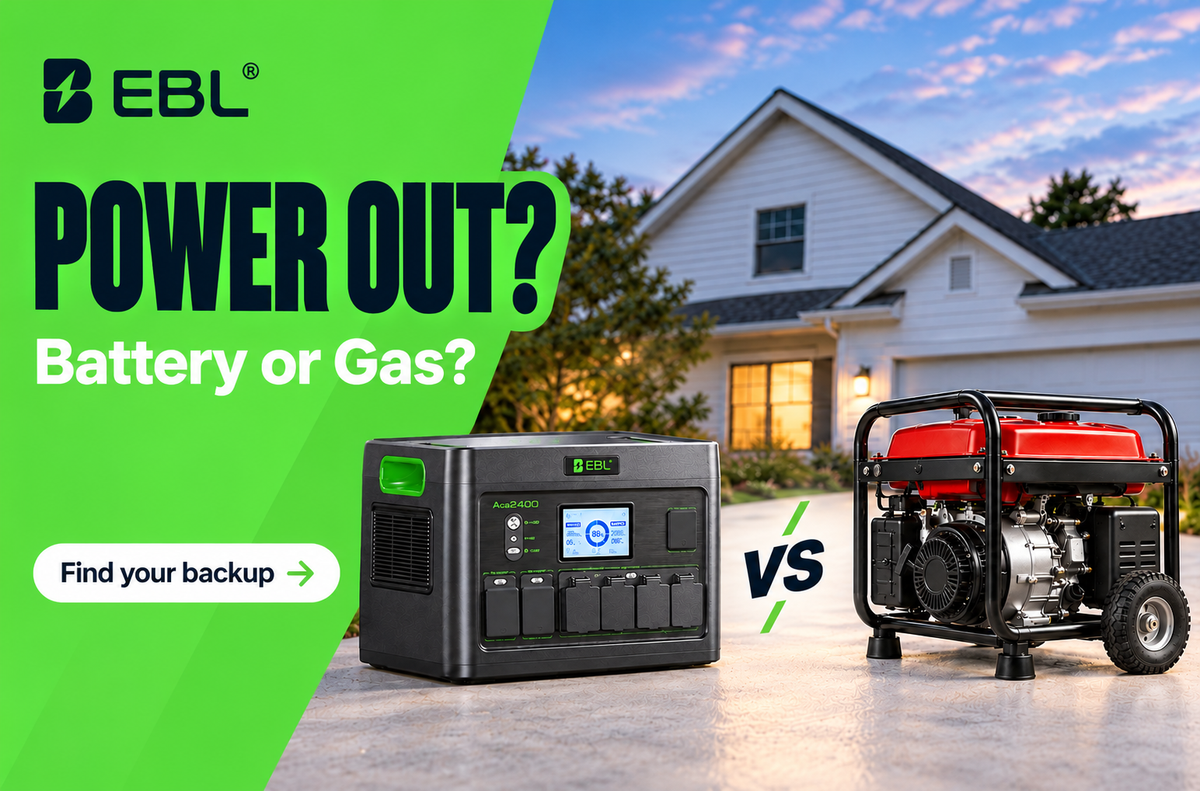
A portable power station is usually the better choice for quiet camping, indoor backup and short outages with modest energy needs. A fuel generator is often more practical for sustained high loads during long outages, provided you have safe outdoor space and fuel. In a portable power station vs generator comparison, check three things: where it can operate, how much power your devices need, and how you will replenish energy.
What Is the Difference Between a Portable Power Station and a Generator?
A portable power station stores electricity in a rechargeable battery and supplies it through AC, DC or USB outputs. An inverter converts stored DC energy into AC electricity for compatible appliances. A fuel generator burns gasoline, propane or another specified fuel to drive an engine and produce electricity.
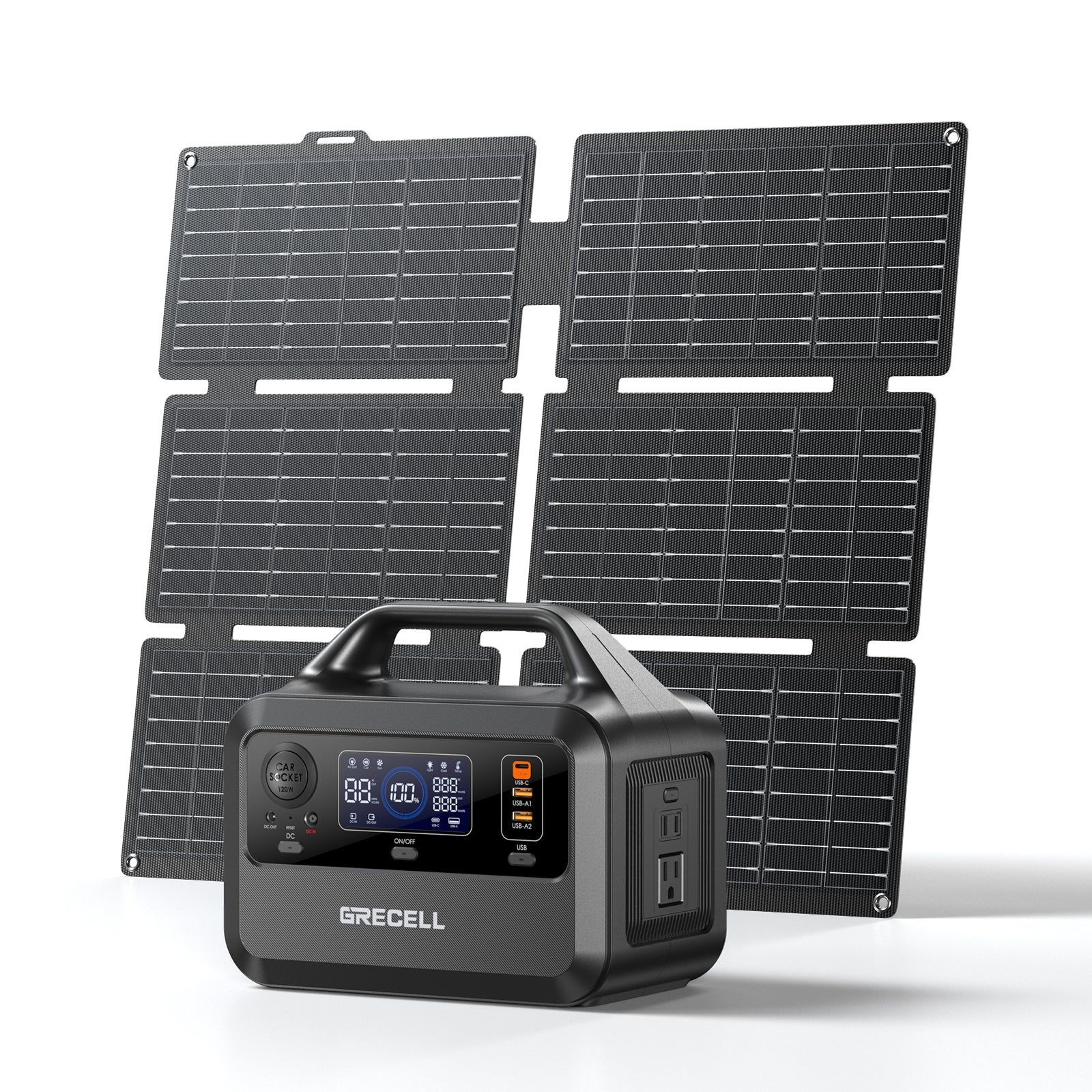
A “solar generator” usually means a portable power station paired with solar panels. The panels generate electricity; the battery stores it for later use. This article compares battery power stations with portable fuel generators, not permanently installed whole-home systems.
| Factor | Portable power station | Portable fuel generator |
|---|---|---|
| Energy source | Stored electricity; recharge from supported wall, vehicle or solar inputs | Fuel converted into electricity while the engine runs |
| Noise | No combustion engine; cooling fans can be audible | Engine and exhaust noise; inverter models can be quieter than conventional designs |
| Indoor operation | No combustion exhaust during normal use; follow battery ventilation and temperature instructions | Outdoor operation only, well away from occupied spaces and openings |
| Runtime limit | Usable battery energy divided by the connected load | Fuel supply, load, tank capacity and required service or cooldown stops |
| Maintenance | Charge management, inspection and eventual battery aging | Fuel management and engine servicing according to the manual |
| Strongest fit | Quiet-hours camping, electronics and planned essential-load backup | Extended high-energy demand where safe outdoor operation is possible |

Which Is Quieter: a Portable Power Station or a Generator?
A portable power station usually makes less noise because it has no running engine. It is not necessarily silent: cooling fans can start under heavier loads or during charging, which matters beside a bed or in a small RV.
Do not assume every fuel generator is equally loud. For example, Honda lists the EU2200i at 48–57 dBA, depending on load. This is a specific inverter-generator example, not a category-wide rating. No comparable EBL sound measurement under the same conditions was verified for this article, so a numerical noise advantage would be misleading.
How should campers compare noise claims?
Compare measurements at the same distance and load, and check campground generator hours before booking. For overnight phone charging, lighting or a small fan, battery power avoids an engine running beside the campsite. Keep the power station's cooling vents unobstructed.
Fuel vs Battery: Which Provides Enough Runtime?
A generator can keep producing energy with an adequate fuel supply and the operating breaks its manual requires. A power station has a fixed stored-energy budget between charges. Watts (W) describe output power; watt-hours (Wh) describe stored energy. A 2400W output rating does not mean 2400Wh of capacity or 24 hours of backup.
Use this runtime calculation before choosing a system
Estimated AC runtime (hours) = battery capacity (Wh) × assumed usable fraction ÷ average device load (W).
For the examples below, the usable fraction is 0.85. This is a planning assumption for conversion losses and unavailable energy, not an EBL laboratory measurement. Temperature, battery age, inverter idle draw and device behavior can change the result substantially, especially at very low loads. USB and DC outputs have different losses.
| EBL model | Continuous output | Listed battery capacity | Estimated runtime |
|---|---|---|---|
| EBL 500W Portable Power Station | 500W | 519Wh | 519 × 0.85 ÷ 100 = 4.4 hours |
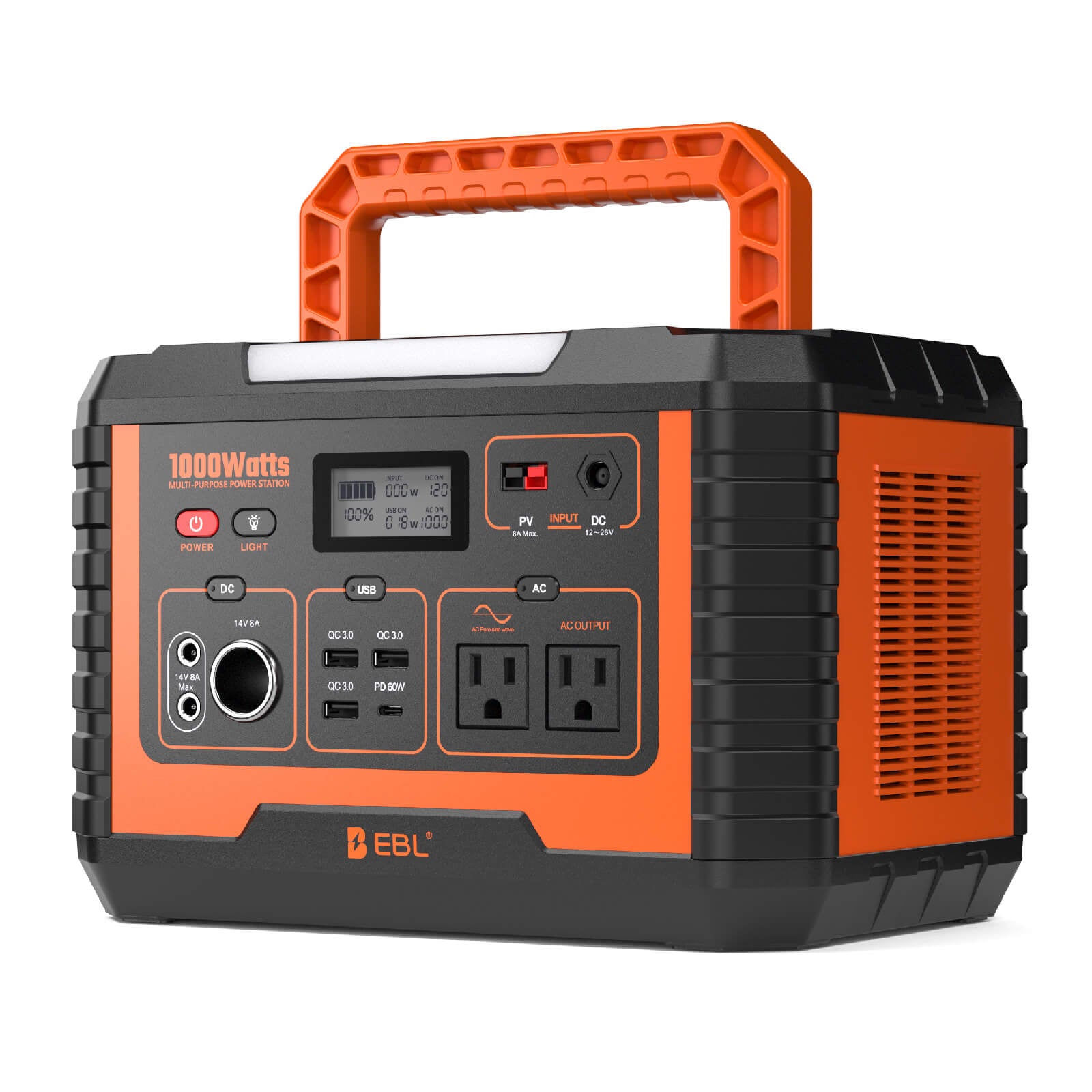
| EBL 1000W Portable Power Station | 1000W | 999Wh | 999 × 0.85 ÷ 100 = 8.5 hours |
| EBL 2400W Portable Power Station | 2400W | 1843.2Wh | 1843.2 × 0.85 ÷ 100 = 15.7 hours |
These capacities refer to the linked models; other EBL products with the same wattage may differ. For a refrigerator, use measured energy over a representative day to estimate average demand, then separately check compressor startup power. A running-wattage label alone cannot predict daily consumption.

Can solar panels replace fuel for repeated use?
Solar can replenish a battery when sunlight and charging compatibility are sufficient. The EBL 100W Solar Panel and EBL 200W Solar Panel offer different collection capacities, but panel wattage is a rated value rather than an all-day charging guarantee.
Illustrative daily solar energy = panel watts × peak-sun-hours × assumed system yield. With four peak-sun-hours and a hypothetical 75% net yield into the battery, a 100W panel collects about 300Wh and a 200W panel about 600Wh. These are scenarios, not forecasts or verified EBL charging results. Peak-sun-hours are equivalent full-strength sunlight hours, not simply daylight hours.
At an assumed 85% delivery efficiency, those stored amounts would supply roughly 255Wh or 510Wh to AC loads. Compare energy on the same side of the system when planning repeated days. Shade, weather, panel orientation and charge-controller limits can reduce output. Confirm voltage, current, connector and maximum-input compatibility before connecting a panel or adding panels.
Can You Use a Portable Power Station or Generator Indoors?
A battery power station produces no combustion exhaust during normal operation and can support indoor loads when used as its manual permits. A fuel generator must never run inside a home, garage, tent or RV, even with open doors or windows.
The CDC recommends operating generators outdoors more than 20 feet from windows, doors and vents, and using a battery-powered or battery-backup carbon monoxide detector at home. An onboard CO shutoff is not permission to operate indoors.
For battery equipment, keep the unit dry, leave ventilation clearance and stop using damaged equipment. Connect appliances through appropriately rated outputs. Never feed either device into a household wall outlet to energize house wiring; fixed home-circuit backup requires suitable transfer equipment and professional installation.

Which Costs Less to Run and Maintain?
A power station avoids engine oil changes and fuel-system servicing, but charging electricity and battery aging still have costs. A generator adds ongoing fuel and engine maintenance. The cheaper overall choice depends on purchase price, energy delivered, frequency of use and replacement costs.
Compare the cost of the same delivered energy
Battery charging cost = delivered energy (kWh) ÷ overall wall-to-device efficiency × electricity rate. For an illustrative 1kWh delivered, 80% overall efficiency and a hypothetical electricity rate of $0.20/kWh, charging costs $0.25.
Generator fuel cost = operating hours × gallons per hour at the actual load × fuel price per gallon. If a hypothetical generator supplies a steady 500W for two hours, consumes 0.15 gallons/hour at that load and fuel costs $4/gallon, it delivers 1kWh for $1.20 in fuel. These assumed prices and consumption figures are not current market averages or specifications for a named generator.
The example excludes purchase price, solar hardware, battery degradation, engine servicing and taxes. Use your own electricity tariff and the generator manufacturer's consumption data at your expected load. Solar has no fuel bill, but its equipment is not free.
What maintenance should you plan for?
For a power station, follow the model's storage-charge guidance, inspect cables and ports, and check readiness before an outage. For a generator, follow its oil, air-filter, spark-plug and fuel-storage schedule. Neither system should be left unchecked until an emergency.
Which Is Better for Camping, RV Travel and Home Backup?
Choose by your appliance list and recharge opportunities, not by the activity label alone. The following original planning scenarios illustrate how an EBL model might fit. They are calculations using assumed loads, not field tests or customer experiences.
| Scenario | Assumed device use | Load energy | Capacity target with losses and 25% extra allowance |
|---|---|---|---|
| 24-hour camping trip | 45W laptop × 3h; 8W light × 5h; 20W fan × 4h; 10W phone charging × 2h | 275Wh | 275 ÷ 0.85 × 1.25 ≈ 404Wh |
| 12-hour RV stop | 25W average portable-fridge load × 12h; 40W laptop × 3h; 10W lights × 4h | 460Wh | 460 ÷ 0.85 × 1.25 ≈ 676Wh |
| 8-hour home outage | 100W average refrigerator load × 8h; 15W router × 8h; 10W lights × 4h | 960Wh | 960 ÷ 0.85 × 1.25 ≈ 1412Wh |
500W: camping electronics and modest loads
The 519Wh EBL 500W Portable Power Station exceeds the camping scenario's calculated 404Wh capacity target. All four assumed devices together draw 83W, comfortably below 500W. A 24-hour trip here includes intermittent device use; it does not mean 24 hours at the maximum rated output.

1000W: RV essentials with a measured fridge budget
The 999Wh EBL 1000W Portable Power Station exceeds the RV scenario's 676Wh target. Confirm the fridge's startup demand, output-port compatibility and actual consumption. This example excludes rooftop air conditioning, electric cooking and water heating, which can radically change the required system.

2400W: selected home essentials during an outage
The 1843.2Wh EBL 2400W Portable Power Station exceeds the home scenario's 1412Wh target. Check the refrigerator's startup load against the unit's surge capability and the duration it can support. This is an essential-appliance budget, not a promise to power an entire house.
High output does not remove the battery limit: a constant 1500W heater would consume the same unit's assumed usable energy in approximately 1843.2 × 0.85 ÷ 1500 = 1.0 hour. For days of heating, air conditioning or heavy tool use, investigate a larger energy system or a suitably sized fuel generator with safe outdoor placement.

A three-question decision model
- Can you operate it safely? If there is no suitable outdoor generator location, choose battery backup sized to essential loads.
- Can it start and run your devices? Add simultaneous running watts. A 20–25% planning allowance can help, but motor startup demand must be checked separately; that allowance does not guarantee startup compatibility.
- Can you replenish the energy before it runs out? Compare daily consumption with realistic charging or fuel availability. If the budget does not balance, reduce loads or choose a different system.
For a device-by-device worksheet, use the portable power station wattage calculator guide. To compare EBL output classes, read the 500W vs 1000W vs 2400W power station comparison.
FAQ
Is a portable power station better than a gas generator?
It is often better for indoor essential-load backup, quiet camping and electronics. A gas generator can be more practical for prolonged high energy demand when outdoor placement, fuel and maintenance are manageable. Match the choice to both watts and daily watt-hours.
Can a portable power station run a refrigerator?
Yes, if it can handle the refrigerator's running and startup demand and has enough usable battery energy. Measure consumption over time: a compressor cycles on and off, so its instantaneous running watts are not its average load.
How long will a 1000W power station last?
Its wattage alone does not determine runtime. A 999Wh model at an assumed 85% usable fraction provides approximately 8.5 hours at a steady 100W, or 1.7 hours at 500W. Real runtime depends on losses, temperature, battery condition and device behavior.
Can I charge a portable power station with solar panels?
Yes, when the unit supports solar input and the panel setup matches its electrical limits and connector. Choose by voltage and current compatibility as well as wattage. Solar collection depends on sunlight and may not replace a full day's consumption.
Is a solar generator the same as a portable power station?
The term usually describes a battery power station paired with solar panels. A power station by itself stores energy; it needs panels or another charging source to replenish that energy.
Can a portable power station replace a whole-house generator?
A small portable unit can replace backup for selected plug-in appliances, but it is not automatically a whole-house system. Whole-home coverage requires assessment of voltage, peak loads, total energy and suitable electrical integration.
Can you use a gas generator indoors with a window open?
No. Open windows do not make indoor generator use safe. Fuel generators must operate outdoors well away from building openings, as described in the CDC guidance above.
Are portable power stations completely silent?
No. They have no combustion engine, but cooling fans can run during charging or higher output. Check model-specific noise measurements and the conditions used to measure them.
Build your backup around the devices you need most. Compare the EBL 500W, EBL 1000W and EBL 2400W Portable Power Stations, then choose compatible solar charging if your daily energy budget calls for it.


Leave a comment
All comments are moderated before being published.
This site is protected by hCaptcha and the hCaptcha Privacy Policy and Terms of Service apply.