


Battery, Inverter & Solar Charging Explained
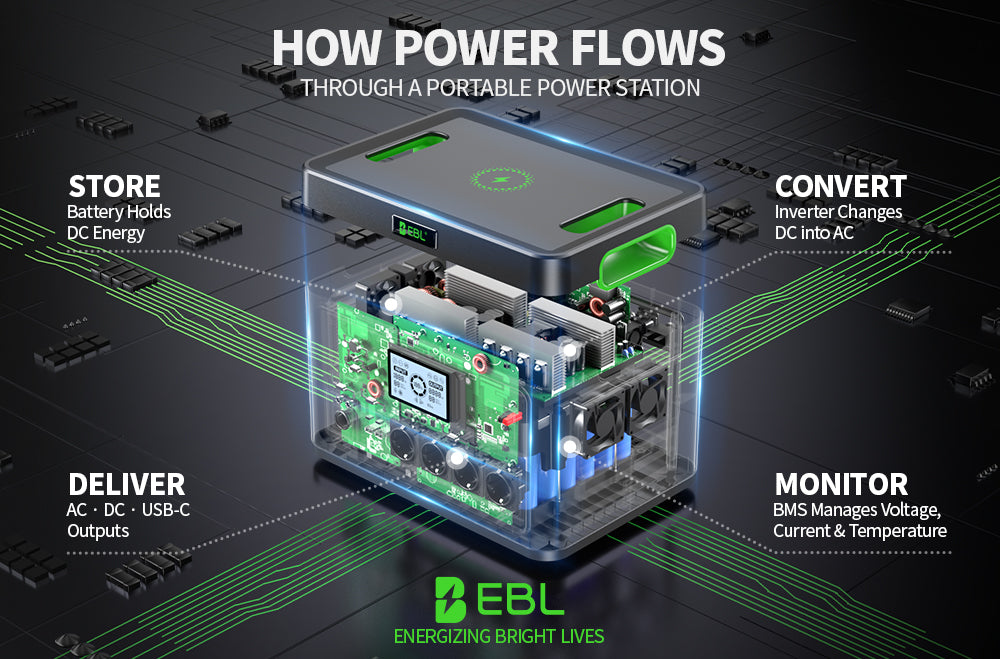
A portable power station stores electricity in a rechargeable battery, converts that energy into the voltage your devices need, and delivers it through AC, USB, and DC ports. Its battery management system monitors temperature, current, and voltage, while a built-in inverter turns battery power into household-style AC power. You recharge the station from a wall outlet, vehicle, or compatible solar panels.
That is the short answer. The useful answer is understanding what happens at each stage—and how battery capacity, inverter output, conversion losses, and appliance startup surges determine what you can actually run.
How Does a Portable Power Station Work?
A portable power station follows a simple energy path:
- Energy enters from an AC wall charger, car socket, or solar panel.
- A charge controller regulates the input so the battery receives safe voltage and current.
- The battery stores the energy as direct current (DC), measured in watt-hours (Wh).
- Power electronics condition the output. DC ports use regulated DC power, while the inverter converts DC into alternating current (AC).
- Your device draws power through the appropriate AC, USB, or DC outlet.
- The battery management system (BMS) supervises the process and can stop charging or output if it detects unsafe conditions.
| Stage | Main Component | What It Does | Why It Matters |
|---|---|---|---|
| Input | Charge controller | Regulates wall, car, or solar power | Protects the battery and manages charging |
| Storage | Battery pack | Stores DC energy in watt-hours | Determines how long devices can run |
| Conversion | Inverter and DC converters | Produces AC and regulated DC voltages | Determines device compatibility and efficiency |
| Output | AC, USB, and DC ports | Delivers usable power to devices | Determines what can connect simultaneously |
| Protection | BMS and safety circuits | Monitors voltage, current, and temperature | Reduces the risk of overload or battery damage |

1. Battery System Explained: Where the Energy Is Stored
The battery is the station’s energy reservoir. Capacity is measured in watt-hours (Wh), not watts. A 1,000Wh battery theoretically holds enough energy to supply 100W for 10 hours, but conversion losses and the station’s protection reserve reduce real-world runtime.
Portable stations commonly use NCM lithium-ion or lithium iron phosphate (LiFePO4) cells. NCM packs can offer strong energy density for their weight. LiFePO4 packs are generally chosen for long cycle life and thermal stability. Cell chemistry affects weight, lifespan, and operating characteristics, but it does not replace the need for a well-designed BMS.
Battery capacity is not the same as output power
This distinction prevents the most common buying mistake:
- Watt-hours (Wh) tell you how much energy is stored.
- Watts (W) tell you how much power the station can deliver at one time.
For example, the EBL 500W Portable Power Station has about 519Wh of capacity and a 500W continuous AC rating. The first number helps estimate runtime; the second tells you whether an appliance can start and run without exceeding the inverter limit.
A practical runtime formula
Estimated runtime (hours) = Battery capacity (Wh) × 0.85 ÷ Device power (W)
The 0.85 factor is a planning assumption for conversion loss and system overhead. Actual efficiency changes with load, output type, temperature, battery age, and whether the appliance cycles on and off. For devices with variable consumption, use measured average wattage rather than the number printed on the adapter.
| Example Load | Station Capacity | Calculation | Planning Estimate |
|---|---|---|---|
| 60W laptop | 519Wh | 519 × 0.85 ÷ 60 | About 7.4 hours of continuous 60W draw |
| 80W average refrigerator load | 999Wh | 999 × 0.85 ÷ 80 | About 10.6 hours at an 80W average |
| 150W mixed backup load | 1,843.2Wh | 1,843.2 × 0.85 ÷ 150 | About 10.4 hours |
These are calculated planning examples, not guaranteed runtimes. A refrigerator’s compressor cycles and may require a much higher startup surge than its average running wattage.
2. What Does the Inverter Do in a Portable Power Station?
The battery stores DC power, but household outlets supply AC power. The inverter converts the battery’s DC electricity into AC electricity so the station can run devices such as laptops, TVs, CPAP machines, refrigerators, and small appliances.
Two inverter ratings matter:
- Continuous output is the power the station can sustain.
- Peak or surge output is the short burst it can provide when a motor or compressor starts.
A device’s running wattage must fit below the continuous rating, while its startup demand must also fit within the station’s supported surge capability. If either limit is exceeded, overload protection may shut off the AC output.
Why pure sine wave output matters
A pure sine wave inverter produces an AC waveform designed to resemble utility power. It is the safer general choice for sensitive electronics, variable-speed motors, audio equipment, medical devices, and appliances with electronic controls. All three EBL models discussed below specify pure sine wave AC output.
3. How AC, DC, and USB Outputs Work
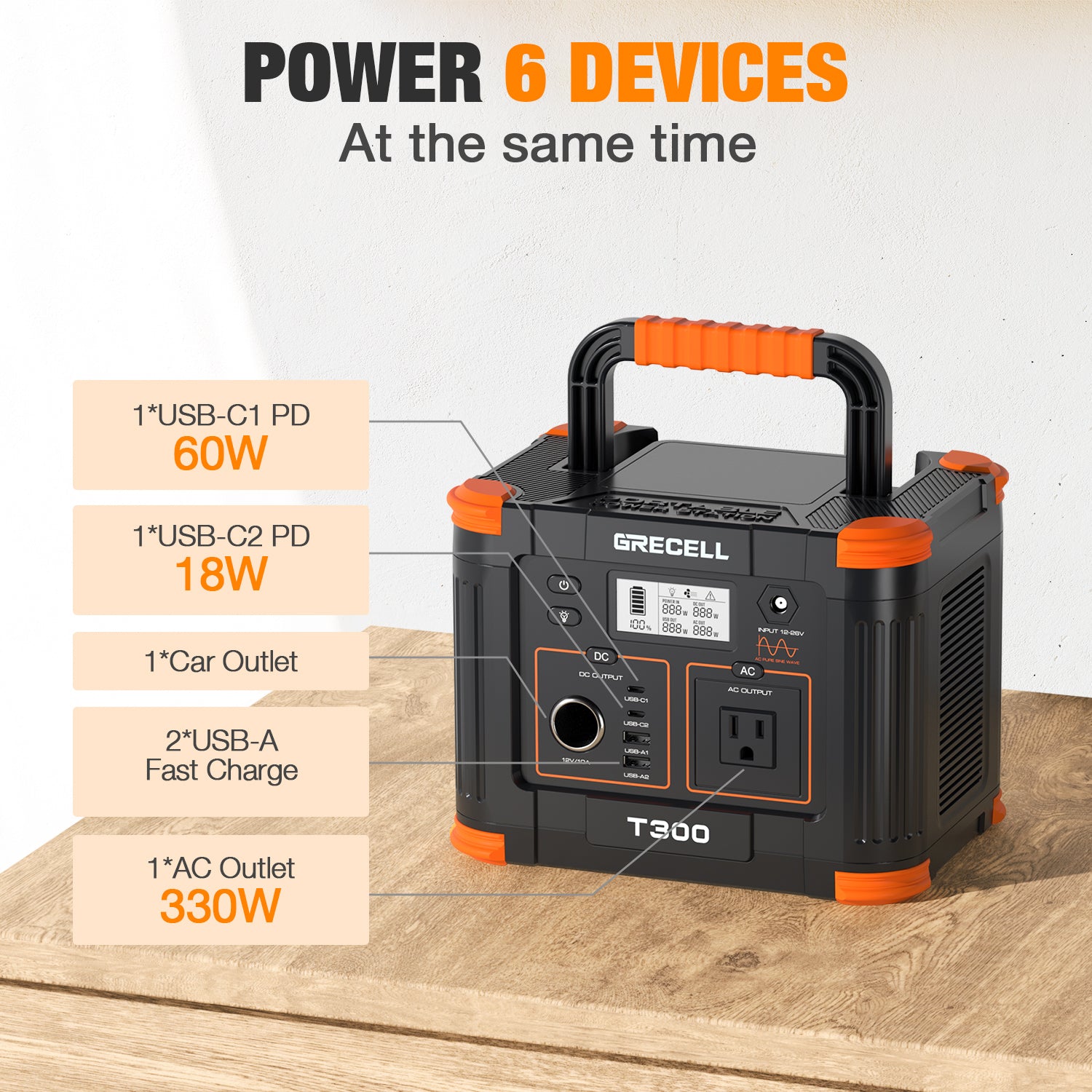
Choosing the correct port can improve efficiency and compatibility. AC outlets require the inverter, adding conversion overhead. USB and regulated DC outputs can often power compatible electronics without converting the battery’s DC energy to AC first.
| Output Type | Best For | Conversion Path | Check Before Use |
|---|---|---|---|
| AC outlet | Appliances, TVs, standard chargers | Battery DC → inverter → AC | Running watts and startup surge |
| USB-C PD | Compatible phones, tablets, laptops | Battery DC → regulated USB-C | Required PD wattage and cable rating |
| USB-A | Phones, lights, cameras, accessories | Battery DC → regulated USB | Supported charging protocol |
| 12V car/DC port | Portable fridges and 12V equipment | Battery DC → regulated DC | Voltage, connector, and current limit |
Efficiency rule: when a device can run directly from a compatible USB-C or DC port, that route may avoid the inverter’s extra conversion step. Compatibility comes first—always match voltage, current, connector type, and polarity.
4. How Does Solar Charging Work?
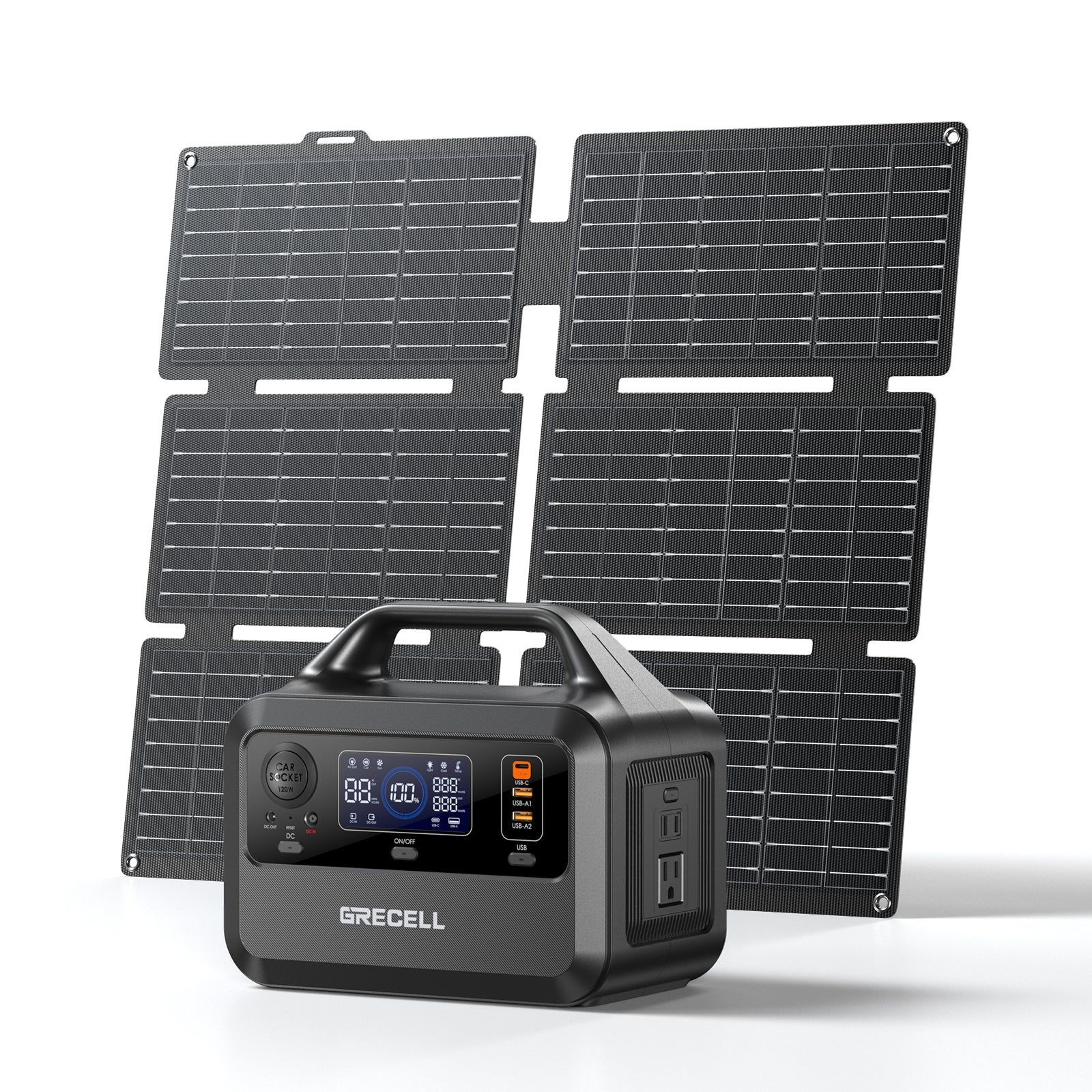
A solar panel turns sunlight into variable DC electricity. The power station’s solar charge controller regulates that input and uses it to recharge the battery. The station can then supply power while away from the grid, provided the panel’s voltage and current are compatible with the station’s input range.
Estimated solar recharge time = Battery capacity (Wh) ÷ Effective solar input (W)
Effective solar input is usually lower than the panel’s nameplate rating because of sun angle, clouds, heat, shading, cable losses, and controller limits. For planning, do not assume a 200W panel will deliver 200W all day.
Solar charging example
Suppose a 200W panel delivers an average of 140W during a strong charging window. A 999Wh station would need roughly 999 ÷ 140 = 7.1 peak-sun hours before additional charging losses are considered. This is a model, not a promise: real conditions can make charging faster or slower.
For compact camping setups, an EBL 100W or 200W portable solar panel can create a modular solar-generator system. Confirm the station’s accepted input voltage, current, connector, and maximum solar wattage before connecting any panel.
5. What Safety Features Protect a Portable Power Station?
A portable power station combines battery-level protection with output protection. Its BMS monitors cells and can intervene when readings move beyond designed limits. Depending on the model, protection may cover overvoltage, undervoltage, overcurrent, overload, short circuit, overcharge, over-discharge, and unsafe temperature.
Safety systems are a backstop, not a substitute for correct use. Keep ventilation openings clear, stay within the published input and output limits, use compatible cables, avoid moisture unless the product is specifically rated for it, and follow the operating-temperature guidance in the manual.
What Size Portable Power Station Do You Need?
Choose in two steps: first verify that the inverter can handle the highest simultaneous load and startup surge; then choose enough watt-hours for the runtime you need. Do not select by the largest appliance alone—build a load list.
Required continuous output = Sum of devices running at the same time
Required capacity (Wh) = Total average load (W) × Desired hours ÷ 0.85
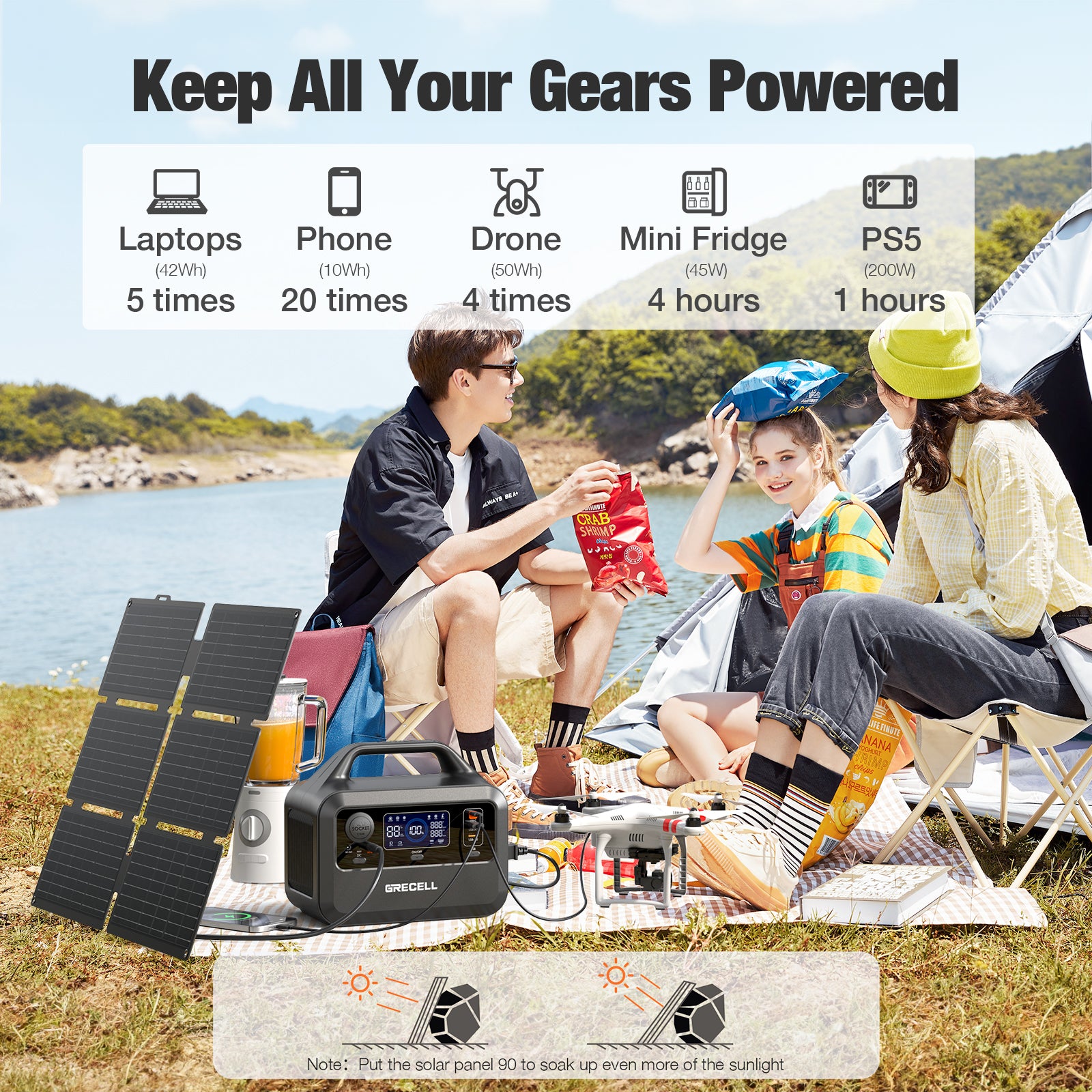
500W portable power station: camping and light essentials
A 500W class station suits phones, cameras, lights, laptops, routers, CPAP machines, and other devices that keep the combined load below the inverter limit. The EBL 500W Portable Power Station combines approximately 519Wh with 500W continuous pure sine wave AC output.
Original 24-hour camping model: two 60Wh laptop recharges (120Wh), four 15Wh phone recharges (60Wh), a 10W light for five hours (50Wh), and a 15W fan for six hours (90Wh) total about 320Wh before losses. This modeled load fits within an estimated 441Wh of usable energy from a 519Wh battery at the 85% planning factor.
1000W portable power station: RV and longer outages
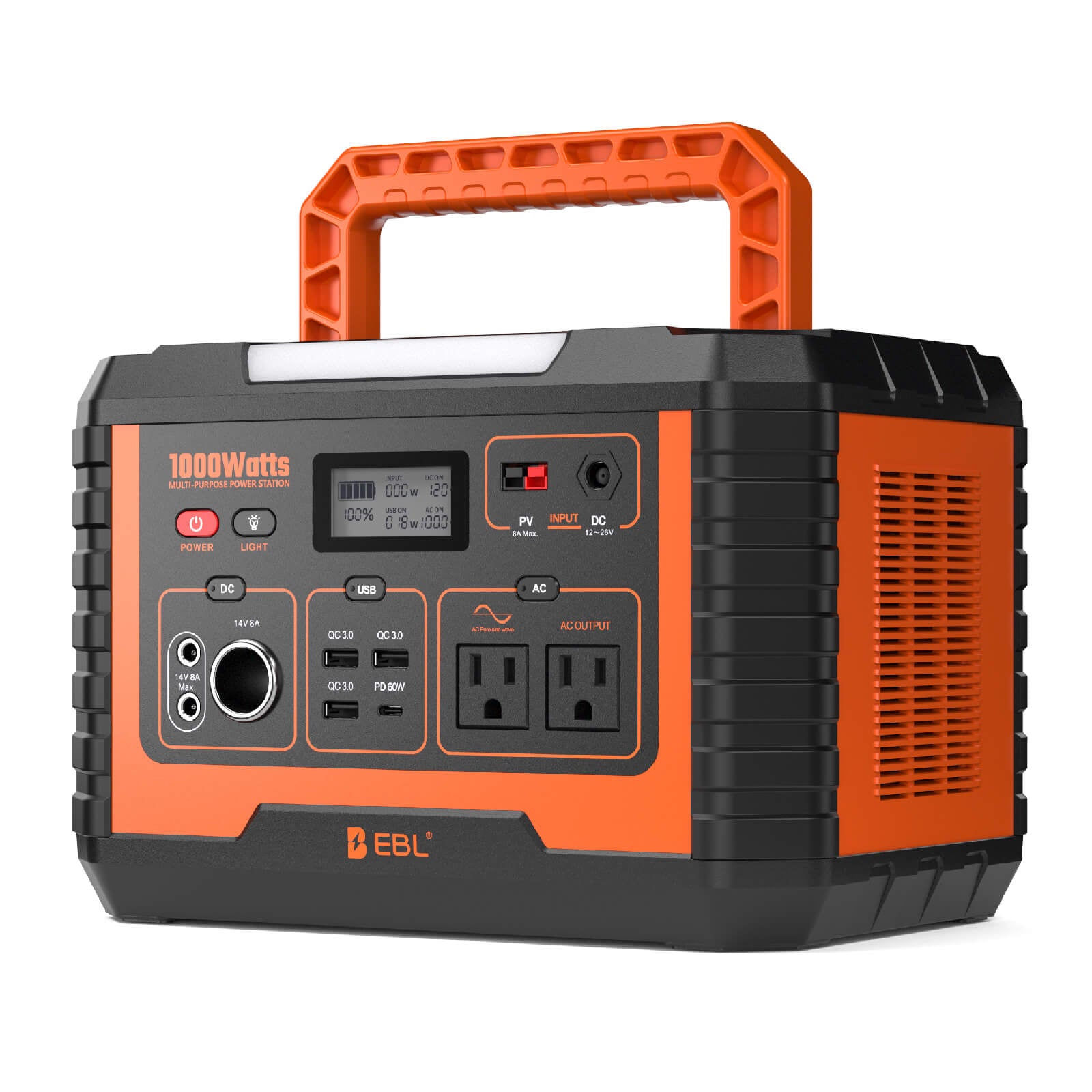
A 1000W class station provides more headroom for a portable refrigerator, entertainment equipment, communications, and multiple devices. The EBL 1000W Portable Power Station pairs 999Wh of capacity with a 1000W rated output.
Original RV day model: an 80W average fridge load for eight hours (640Wh), a 10W router for eight hours (80Wh), and 100Wh for phones and lights total about 820Wh. A 999Wh battery provides an estimated 849Wh after applying the 85% planning factor, leaving little margin. Solar input or reduced runtime would be prudent.
2400W portable power station: home backup and higher-power loads
Home backup requires both greater capacity and higher inverter output. The EBL 2400W Portable Power Station uses a 1,843.2Wh LiFePO4 battery and provides 2400W continuous pure sine wave AC output, with 4800W peak output listed in its specifications.
Original outage model: a refrigerator averaging 80W for 12 hours (960Wh), a 12W router for 12 hours (144Wh), four 10W lights for five hours (200Wh), and 150Wh for phones and laptops total about 1,454Wh. Estimated usable energy is about 1,567Wh at the 85% factor, creating a modest planning buffer. Actual compressor cycling and surge must still be checked.
A Simple Three-Gate Decision Model
- Power gate: Is the station’s continuous wattage above the total simultaneous running load?
- Surge gate: Can it support the largest motor or compressor startup surge?
- Energy gate: Does usable Wh cover the required runtime, including a margin for conditions and aging?
If a station fails any gate, move to a higher-output or higher-capacity model, reduce the number of simultaneous devices, or shorten the target runtime. As a quick starting point: choose 500W for light camping electronics, 1000W for RV essentials and longer device use, and 2400W for broader home-backup loads—then verify with the formulas above.
Portable Power Station vs. Gas Generator
A portable power station stores electricity and runs without fuel combustion at the point of use, so it is quiet and produces no direct exhaust while operating. A gas generator creates electricity by burning fuel and can often run as long as fuel is available, but it creates noise and dangerous exhaust. Never operate a fuel-burning generator indoors or in an enclosed space. A battery power station is rechargeable and convenient for electronics, camping, RV use, and indoor emergency loads, while a generator may suit extended high-power needs where safe outdoor operation and fuel storage are available.
Final Answer: From Stored Energy to Usable Power
A portable power station works as a rechargeable energy hub. The battery stores DC energy, the inverter creates household-style AC, regulated ports serve USB and DC devices, the charge controller manages incoming wall/car/solar energy, and the BMS supervises safe operation. To choose one correctly, compare watts for device compatibility and watt-hours for runtime.
Ready to size a system? Start with your device wattages and desired runtime, then compare the EBL portable power station range and compatible solar panels.
FAQ
Can a portable power station run a refrigerator?
Yes, if the station’s continuous and surge ratings can handle the refrigerator’s compressor and the battery has enough watt-hours for the desired runtime. Check both measured running wattage and startup surge. Refrigerator cycling makes measured average consumption more useful than a simple maximum-watt calculation.
How long will a 1000W portable power station last?
The 1000W rating describes maximum output, not duration. Runtime depends on battery capacity and load. For a 999Wh station powering a steady 100W device, the planning estimate is 999 × 0.85 ÷ 100, or about 8.5 hours. Real results vary.
Can you use a portable power station while it is charging?
Some models support powering devices while charging, but behavior and output limits vary. Check the product manual for pass-through charging, UPS/EPS behavior, supported ports, and any combined input/output restrictions before relying on it.
Can I charge a portable power station with solar panels?
Yes, when the panel voltage, current, connector, and total wattage are compatible with the station’s solar input specification. Solar recharge speed depends heavily on weather, shade, panel angle, temperature, and controller limits.
What is the difference between watts and watt-hours?
Watts measure the rate of power being used or delivered. Watt-hours measure stored energy over time. Use watts to check whether a station can run an appliance, and watt-hours to estimate how long it can run.
Is a portable power station safe to use indoors?
Unlike a fuel-burning generator, a battery power station produces no combustion exhaust at the point of use. It should still be operated according to the manual, with ventilation openings clear and away from moisture, excessive heat, and incompatible loads.
Does a portable power station need a pure sine wave inverter?
Pure sine wave output is recommended for broad compatibility, especially with sensitive electronics, medical devices, appliances with electronic controls, and motor-driven equipment. Always confirm the device’s power requirements.


Leave a comment
All comments are moderated before being published.
This site is protected by hCaptcha and the hCaptcha Privacy Policy and Terms of Service apply.